

An estimated 47% of infants have some form of plagiocephaly (a flat spot on the head), and up to 10% will eventually need a corrective helmet to help reshape their skull. Some research suggests that this intervention may be more common in preterm babies.
All that to say — when Jessica and Russell took their seven-month-old son Kayden, who had been born at 33 weeks, to get fitted for his corrective helmet in October 2024, the appointment should have been routine.
It was anything but.
Prior to the appointment, Kayden’s parents hadn’t noticed any signs that something might be off. In fact, despite having spent five days in the NICU for a low birth weight when he was born, Kayden seemed to be healthy and joyous — “the happiest baby,” Jessica describes.
But the tone of the appointment shifted when Kayden couldn’t hold his head up for imaging. “Then,” says Jessica, “the doctor pointed out that he had developmental delays and lacked muscle tone.”
A switch had flipped and his parents suddenly found themselves hyper-aware that Kayden’s development was becoming abnormal. He stopped gaining weight, necessitating GI specialist visits, and developed strabismus (eye misalignment).
A neurology appointment led to genetic testing. The results? Negative across the board. As Kayden’s health became increasingly complex, the family was sent to the local children’s hospital for failure to thrive — a condition where a child isn’t growing (in height or weight) as expected. Doctors decided to pursue more extensive testing in December 2024: a comprehensive genetic panel and brain MRI.
“And that’s what changed everything to give us his diagnosis. We received the results in early January 2025,” says Jessica. “Kayden was diagnosed with XLID98.”
What is XLID98?
X-linked intellectual development disorder 98 (XLID98) is a rare genetic neurodevelopmental disorder caused by NEXMIF gene mutations. This gene plays a critical role in brain development by helping neurons grow properly and form connections.
As the name suggests, XLID98 is inherited in an X-linked pattern. This means that affected males usually have more severe symptoms or manifestations, while females with this disorder may range from relatively unaffected to heavily impacted. According to the XLID98 Foundation:
Females tend to have more difficulties with seizures, including intractable seizures. On the other side, males tend to have greater difficulty with communication and intellectual development.
Kayden is one of just 298 known individuals in the world living with XLID98. But this puts his family in a tough position. As Jessica explains, “Since XLID98 is so rare, doctors don’t have much information to give us. We know he is at a higher risk for autism and seizures. But I don’t know what it means for his future, especially since he’s so young right now. Right now, all I can say is that I have a one-year-old who is developmentally more like a six to eight month old.”

Research and understanding around XLID98 is still slim — and the community would love to see a greater research focus dedicated to understanding XLID98, its manifestations over time, life expectancy, and potential treatments.
What we do know about XLID98 now is that XLID98 may cause:
- Developmental and intellectual delays
- Autism spectrum disorder
- Epilepsy
- Failure to thrive
- Microcephaly (a small head size)
- Feeding difficulties
- Gastroesophageal reflux (GERD)
- Muscle spasticity
- An unstable gait
Approaching Care Difficulties
XLID98’s extreme rarity creates unique challenges for families. Many doctors have never, and may never, see someone with XLID98. There are no established treatment protocols or clinical guidelines either. This means families must focus on managing symptoms as they appear rather than following a proven treatment plan.
“Of all the things, how and why does he have something so rare?” Jessica questions. “Not only do we need to find a way to support him and adjust our lives, but it’s hard to know how to do that when we don’t know what to expect.”
As support, the family has been relying on a Facebook group where they’ve connected with other families. These groups are especially important for rare disease communities, as these are usually the best place to get advice and information from experts — and yes, parents, caregivers, and individuals with rare conditions are experts in their conditions.
Jessica shares, “The families are so supportive. It’s so nice having people to talk to and ‘compare’ symptoms. It’s a safe space to say, ‘this is what’s wrong,’ and have it make sense to people.”
Having people who understand is also helpful when dealing with the compounding medical difficulties. It can be frustrating to seek out and find quality care even without being part of the rare community. “But having to go through referral after referral, hours on the phone, and insurance coverage denials make it so much harder than it needs to be,” Jessica says.
Kayden Today
Jessica can’t help but smile when she thinks about Kayden, the youngest of her three boys, the one who “perfectly completed our crazy family of five.”
Despite the challenges he’s faced — which include two hospitalizations for failure to thrive, a G-tube placement, and four total hospital stays — he is bubbly, resilient, and social. He loves hanging out with his ten-year-old and four-year-old brothers, and “is very easy-going. There isn’t a lot that bothers him.”
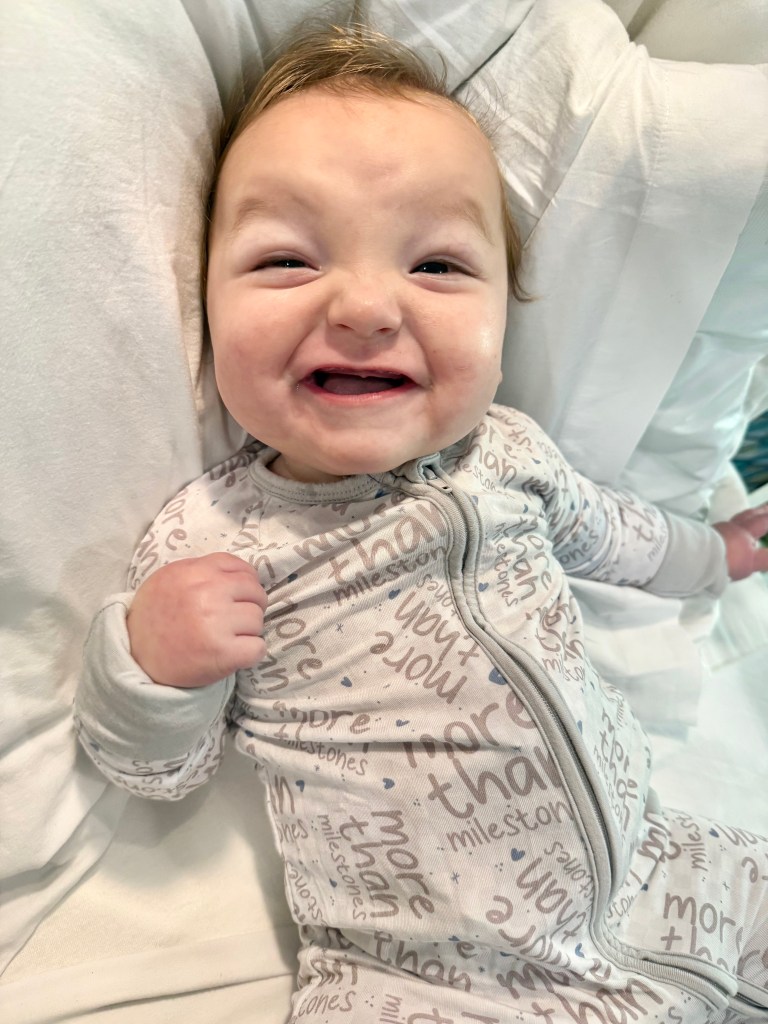
Every second his parents spend with Kayden is rewarding: “His smile, his laugh, his resiliency. Seeing him thrive when we didn’t know if we would and all the things he’s been doing, like rolling over and sitting up, that we weren’t sure he would.”
At the same time, Jessica deals with a dichotomy that many parents in the rare disease space understand: the bittersweet balance of celebrating milestones while dealing with the challenges that inevitably come with a diagnosis.
“Don’t get me wrong, Kayden is perfect in every single way,” she says. “But I’d be lying if there wasn’t a sense of grief for the childhood I wanted him to have. It can also be hard to navigate the needs of his brothers with everything we need to do for Kayden, all of the hospital stays and appointments. But we keep each other going. I don’t know how I’d survive this without my my husband, our kids, and our families.”
As she considers what the future might bring, Jessica notes that Kayden might be having some absent episodes that the family is monitoring to see if they’re seizure-related.
“We move a few steps forward, then take a few steps back,” she says. “But that’s ok. Because when we take those steps forward, they are so incredibly precious. And even though this has changed our lives, it has not defined us and will never define Kayden.”
The Need for XLID98 Awareness
XLID98 is considered an ultra-rare condition — but Jessica believes that “there may be people living with this disorder that don’t know it because it’s so rare and so difficult to get the right testing done.” By sharing her family’s story, she hopes to inspire others to advocate for their children — and to ask for help when they need it.
“I want other families to reach out for help if they think something is ‘wrong.’ This entire process is scary, overwhelming, and hard. But we are not alone. We don’t have to share the same diagnosis to support each other,” she says.
At the same time, by sharing Kayden’s story and raising XLID98 awareness, Jessica hopes there can be a step in the right direction in terms of research.
“Maybe, just maybe, someone will come across our story and find a way to help us further research goals,” she shares. “We will continue to fight for research and support.”
You can follow along with Kayden’s journey on Instagram or learn more about XLID98 through the XLID98 Foundation.
 Rareatives
Leave a comment