

There’s nothing like the rousing connectivity of a baseball game: fans united in one stadium, all cheering for something bigger than themselves. When 17-year-old Connor Martin visits Target Stadium to watch the Minnesota Twins play, he’s fully drawn into the atmosphere. He looks up, watches the sky, watches Byron Buxton’s home run ball flying over the fence. With a smile, he cheers for his team.
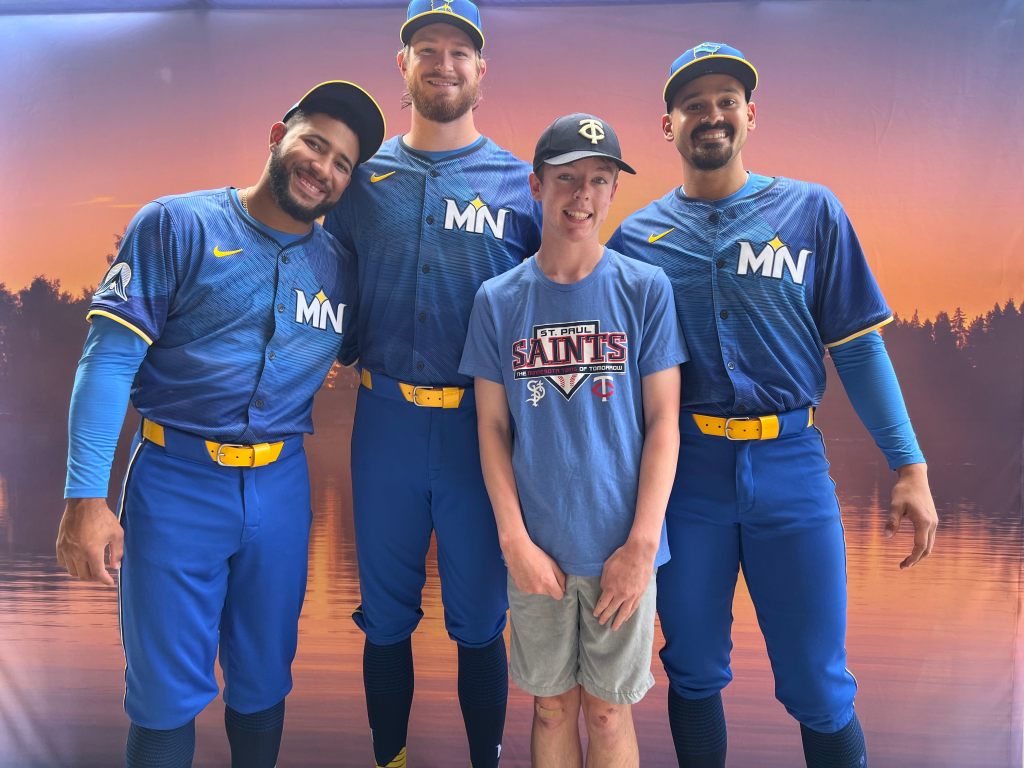
His family, including his mother Jessica, were not sure if Connor would reach this point. Three years ago, when he was diagnosed with Niemann-Pick disease type C (NPC), Connor had vertical supranuclear gaze palsy—limited up and down eye movement—and difficulty walking, balancing, and even swallowing.
But today, thanks to the approval of MIPLYFFA® (arimoclomol capsules), Connor’s speech has grown clearer, his balance steadier. He even plays adaptive soccer in a league that celebrates each player’s unique abilities, “a really meaningful activity for him as a high school student,” shares Dr. Jessica Goldstein, MD, a pediatric neurologist with M Health Fairview and associate professor with the University of Minnesota Medical School, who leads Connor’s care team.
Families of children with NPC once faced significant uncertainty. Years went by as families and pharmaceutical companies chased MIPLYFFA® approval. But now multiple FDA-approved therapies are available: MIPLYFFA® in conjunction with miglustat, as well as AQNEURSA™ (levacetylleucine). The medications Connor takes daily are integral to his daily routine and his family’s renewed sense of possibility. Of course, this therapeutic revolution comes with its own complexities. Connors’ recent breakthrough seizures, even though other symptoms continue improving, illustrate how progress in rare disease is rarely linear.
Through conversations with Jessica and Dr. Goldstein, Rareatives unpacks the challenges and hope of raising a child with a rare disease, the evolving treatment landscape, and how access can genuinely change trajectories.
The Pandemic’s Difficulties
As the oldest of three brothers, Connor has always led the way in his family. “When it came to Connor, he hit all of his milestones, some ahead of schedule. He was an early reader and very good in school,” says Jessica.

So Jessica and her husband didn’t immediately worry when Connor’s academic performance dropped during the pandemic. She explains, “He became a little slower and his response times weren’t the same. His clumsiness was more pronounced too. But a lot of it could be explained away. He was in sixth grade, so clumsiness could’ve been related to a growth spurt. We did blood tests, which came back with nothing. As for school, according to the media, many students were struggling with online learning.”
However, as time passed, Jessica and her husband couldn’t ignore the undeniable signs. They took Connor to the Masonic Institute for the Developing Brain to have Connor evaluated.
“We thought maybe he had high-functioning autism or depression or anxiety,” Jessica shared. But nothing could prepare her for what she saw during Connor’s first appointment. Simple requests for Connor to perform jumping jacks revealed the extent of his motor difficulties. With each subsequent struggling movement, fear hardened in Jessica’s stomach.
The doctor made a slew of referrals: physical therapy, speech, and eventually neurology.
“I Had Never Seen a Patient with NPC…”
Niemann-Pick disease type C affects roughly one in 120,000 people, making it likely that most physicians may never meet someone with this condition. Symptoms also vary dramatically between affected individuals, and early signs often overlap with more common conditions.
When the Martin family was referred to Dr. Goldstein, she had never worked with a family in the NPC community before. At first, Dr. Goldstein and the Martin family explored other potential diagnoses.
“When I met Connor, I was not sure what he had initially. NPC was on my list, but I thought it was likely a more commonly seen condition instead,” she shares. Still, just to be prepared, she proactively reached out to NPC expert, Dr. Mark Patterson of Mayo Clinic, to discuss NPC and potential treatments.
Four months of testing passed, and Connor’s symptoms seemed to worsen by the day. “He had ataxia, tightness in his legs, and slow movements,” said Dr. Goldstein.
Whole genome sequencing came back inconclusive. “The gene he got from me is an extremely rare intronic mutation that took time to find,” Jessica shares. Eventually, it was high oxysterol levels in a blood draw that revealed the devastating diagnosis.
Jessica remembers being absolutely stunned. “I wanted it to be anything else, anything that they could fix,” she says.
What is Niemann-Pick Disease type C?
Niemann-Pick disease type C (NPC) is a rare and progressive genetic disorder caused by NPC1 or NPC2 gene mutations. As a lysosomal storage disorder, NPC prevents cells from properly metabolizing lipids (fats) and cholesterol, which build up and damage cells. NPC is an incredibly variable disorder in terms of manifestation and age. It may appear in early infancy, early childhood to teenage years, or even in adulthood (as the late-onset form).
Signs of NPC can include, but are not limited to:
- Vertical supranuclear gaze palsy
- Slurred speech
- Dysphagia (difficulty swallowing)
- Clumsiness
- Hepatosplenomegaly (enlarged liver/spleen)
- Speech delays or difficulties
- Seizures
- Hearing loss
- Failure to thrive
- Fetal ascites (abnormal fluid accumulation in the abdomen)
- Weak muscle tone
- Neurological or psychiatric symptoms (most common in the late-onset form)
Pushing Towards Treatment
Both Dr. Goldstein and the Martin family found themselves in unknown territory. But Dr. Goldstein approached the situation with transparency and a clear understanding that she would do everything she could to support the family, openly discussing treatment options she learned about by leveraging her expert networks. This included asking Dr. Patterson how the family could get involved with a clinical trial to access arimoclomol.
“We were able to bypass the vetting process for a clinical trial, schedule an appointment in January, and start Connor on the trial drug a few months later, and that’s because Dr. Goldstein had done her homework,” says Jessica, her voice full of gratitude. “Dr. Patterson’s goal is to cure NPC from the world, and Dr. Goldstein wants to cure Connor directly. I truly value them both.”
During this time, Dr. Goldstein explains, she also “drew out an entire teaching page for Connor” to make sure he understood more about the diagnosis, the drugs, and even treatments on the horizon.
Connor’s diagnosis and treatment coincided with remarkable therapeutic advancement in the NPC space. Prior to this, families primarily used miglustat off-label. Access to experimental therapies required clinical trial enrollment, like the one Connor had access to.
But the clinical trial really seemed to work. “Connor has really responded well to the multiple therapies,” says Jessica. “When we added arimoclomol concomitantly with miglustat, we saw noticeable improvement in his symptoms. His ataxia got better. His speech got clearer. He can balance more, and his eye movement really improved. This treatment has helped his life be fuller.”

A Treatment Revolution’s Promises and Limitations
The MIPLYFFA® approval represented a watershed moment for families. “This approval was completely game-changing,” says Dr. Goldstein. “Not only do families have a medication specific to NPC, but it is commercially available and oral, so you can take it at home in combination with miglustat. Families don’t have to massively disrupt their routine, enhancing patient-friendliness. It really brings hope and a different timeline of what to anticipate.”
But while MIPLYFFA® offers promise for the future, it also comes with significant questions and challenges around access and use. “The community is running into a lot of barriers,” Jessica tells me.
Connor currently takes multiple NPC medications simultaneously, joining a growing population of patients receiving combination therapy without clear guidance about drug interactions or optimal dosing strategies. “We don’t know as much about combining several of these newly approved medications, although they are being combined in clinical practice,” Dr. Goldstein shares. “As more patients are on combination treatment, we need to continue to evaluate the results to better understand the experience. What are the pros and cons we didn’t anticipate?”
From here emerges another critical gap in the NPC case: the absence of reliable biomarkers to guide treatment decisions or measure outcomes. Without biomarkers of disease activity, physicians and families must rely on clinical observation and functional assessments to evaluate treatment effectiveness. This approach works reasonably well for obvious improvements, but becomes problematic when new symptoms emerge or when subtle changes occur over time.
Jessica emphasizes the need for better measurement tools: “The disease is heterogenous. You can’t look at symptoms and automatically tell whether a child is better or worse. Connor has lots of test scores that say he’s doing better. But he’s having breakthrough seizures right now. Is this progression, since he’s not getting globally worse? Everyone shows symptoms differently and responds differently to medicines too. We need a way to access everything, and run further testing, because we don’t know which combinations will save our individual children. And without biomarkers, we can’t demonstrate biochemically whether treatments are helping.”
Better biomarkers should be a research priority. For families facing decisions about experimental treatments or clinical trial participation, biomarkers could provide the evidence needed to make informed choices.
At the same time, clinical trials also present some complexity, especially as no drugs are being evaluated together — and access, which can provide some anecdotal evidence, can be hard to come by. Jessica notes that many parents may also struggle with enrolling their children in clinical trials, especially those with placebo arms.
“Each study has its own eligibility criteria, often limiting the use of the medicine you are currently taking and there’s no guarantee your child would be given the trial medicine,” says Jessica. “In a disease when there’s no going back — once the brain cells are gone, they’re gone — how do you ask parents to flip a coin on their child?”
Addressing Cost Barriers
Another barrier to accessing care is the sometimes astronomical cost. NPC medication can cost hundreds of thousands of dollars annually. Considering combination therapy for optimal outcomes could place an impossible financial pressure on families, especially since insurance companies may not cover all approved therapies in combination.
“Parents have a choice: one incredibly expensive medicine or the other, since insurance won’t let you do both. This forces parents to decide which they think will be better for their child. We know that none of these treatments alone are enough, but what will it take?”
Potential NPC treatments, which could be more effective, are beginning to make their way through trials. Some parents could eschew the costly treatments in favor of trying to enroll their child in a trial. However, this clearly has its own complexity.
Being an Advocate
As Jessica reflects on the MIPLYFFA® approval, she has hope. For Connor, for science, for the NPC community as a whole. But there are still nagging worries. With a sigh, Jessica says, “It’s hard. I love these medicines. They’ve given us time — they are giving us time — but they’re not fixing it. None of these medicines are curative, just made to slow down NPC progression. But how do we know how long it slows for and what his quality of life will be?”
These questions continue to push Jessica to be an advocate, and are reflective of the advocacy the rare disease community must largely engage in to get people to hear them. Jessica has participated in FDA testimony, insurance appeals, and community organizing efforts aimed at improving treatment access and research funding.
Effective rare disease care increasingly depends on this advocacy. Families and patients become experts in their condition and must push for the medical community to listen.
“It has been very humbling to have learned so much from Jessica and Connor, and to see what fierce advocates they are,” says Dr. Goldstein. “I feel like this is such a huge component of life in the rare disease space: advocacy for access to expensive treatments, to trials and data, to getting those treatments approved.”
Dr. Goldstein has begun integrating advocacy into her practice, inspired by her work with Jessica and Connor. She recently reinstated the child neurology residency training program with a core goal to prepare child neurologists to work with and better understand neurodiversity, neurogenetics, and rare diseases, saying, “You may only see a child with a specific condition once or twice in your career, but it’s important to understand the diagnostics and management, and how those are specific to each individual condition.”
Dr. Goldstein acknowledges that some individuals may struggle to advocate for themselves both on a broader scale or in micro during appointments. She points out that families can prepare for appointments by knowing your story and what you want to convey.
“Don’t be afraid to question your doctors and bring thoughts to your appointment. Jessica is always bringing me questions or things that she’s read so we can collaborate with her as an integral member of Connor’s entire care team,” Dr. Goldstein says.
Finding Support
Connor’s story continues to develop, but it demonstrates both remarkable progress and the persistent challenges that families face. But, as Jessica found out, she and Connor are not alone. The NPC community is united in its goal.

As such, Jessica encourages any families of loved ones with NPC to reach out for help and support. “There is strength in numbers — community strength, but also individual strength,” she tells me. “I have met NPC mom friends who are there to listen. They have walked this path before me, and now I’m doing that too. It feels dark a lot, like the walls are closing in. But it helps to know that there are people that will try to help you navigate.”
For additional connection to those within the NPC community, please reach out to the National Niemann-Pick Disease Foundation (NNPDF). The NNPDF provides resources, support, and advocacy for families affected by Niemann-Pick diseases. To learn more about NPC, access support resources, or connect with the community, visit nnpdf.org.
For any medication prescribed, always read the Full Prescribing Information and Patient Labeling.
 Rareatives
Leave a comment