
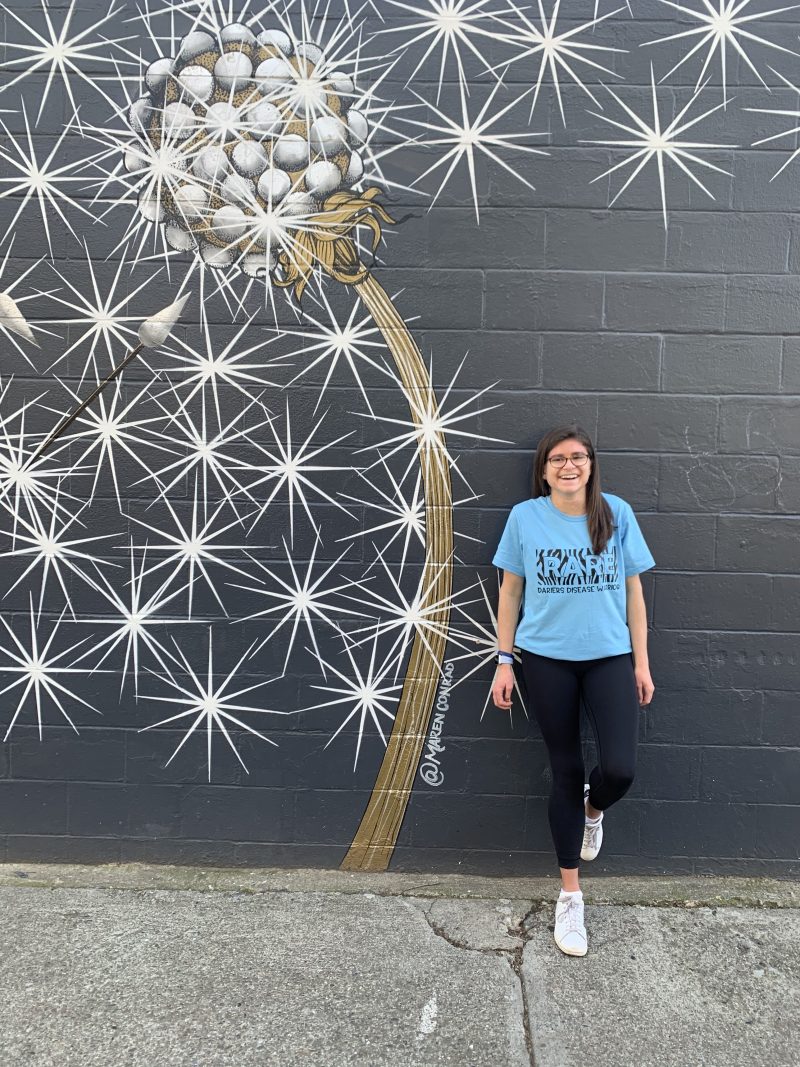
Genevieve Lee’s students may have noticed something different about their teacher’s skin, but they’d never asked about it directly. But Genevieve remembers the exact moment when she realized her students could be allies in rare disease advocacy. She was celebrating Rare Disease Day, which happens annually on February 28th, and wanted to share her Darier’s disease diagnosis with her class.
Her students’ responses exceeded anything she could have imagined. “I had a great relationship with that group of students,” she tells me. “Seeing them be passionate about rare disease awareness, wearing stripes, and asking thoughtful questions meant a lot to me.”

But the impact extended beyond that initial first conversation and Rare Disease Day. By the next year, the students celebrated again, even though they were no longer in Genevieve’s homeroom. With a smile, she reflects, “It was just really special getting the word out about rare diseases.”
Watching her students seriously engage with rare disease education and advocacy was incredibly impactful for Genevieve, whose experience growing up with Darier’s disease wasn’t always easy. She had often felt challenged with how much of her medical reality she could share with others, especially given a general lack of understanding around rare diseases.
More than that, her classroom experiences reflect her commitment to raising Darier’s disease awareness and connecting the community through Decoding Darier’s, a Darier’s disease support group that brings together people with this condition together. In her discussion with Rareatives, Genevieve shares her personal story of living with Darier’s disease, building community, and where she sees Decoding Darier’s heading in the future.
Genevieve’s Story
Her path to advocacy began much earlier in life, when Genevieve was diagnosed with Darier’s disease at six years old. Also known as Darier disease or Darier-White disease, and previously called keratosis follicularis, Darier’s disease is a rare genetic skin disease caused by ATP2A2 gene mutations.
Because Darier’s disease follows an autosomal dominant inheritance pattern, multiple family members are typically affected when the condition appears in a family line. Each child of an affected parent has a 50% chance of inheriting the mutation and developing the condition. However, genetic testing showed that Genevieve’s mutation was spontaneous rather than inherited.
“That was a challenge growing up for me,” she explains. “It’s a genetic disease, so you would assume other people in my family had the mutation, but they don’t. It was difficult knowing that I was dealing with something they couldn’t necessarily understand or relate to.”
Darier’s disease causes lesions and plaques to develop on various areas of the body. The lesions may crust or scale over, thicken and coalesce, or cause issues like itchiness or secondary infection. For Genevieve, Darier’s disease affects her face, scalp, neck, back, and stomach. Each affected area presents differently, she explains, with some regions healing while others are experiencing active flare-ups. The unpredictable nature of Darier’s progression made daily management hard.
Although she began treatment with Northwestern Medicine’s Dr. Amy Paller at age eight — “I definitely have the right care,” Genevieve says. “She’s wonderful.” — Genevieve describes a childhood fraught with flare-ups and different topical medications.
“I’m the middle child, and trying topicals was a challenge because I saw my siblings not having to do that. It’s such a minor thing, but my sister and I have the same hair texture and curls. Even just having to do different scalp treatments made me feel isolated. My brother didn’t quite understand until he was older why I had to try lotions, or why I had to stay out of the sun as much,” she explains.
The troubles were compounded by some of the more negative skin reactions: stinging, burning. When she expressed that a treatment made her uncomfortable, she was often told to wait a few weeks and the hassle would pass. Genevieve found herself serving dual roles as both patient and educator within her family, explaining why certain activities her siblings took for granted — like spending a full day at the beach, trying a new soap, or participating in outdoor sports without careful planning — required extensive consideration and preparation for her.
Teenage Years and Beyond
Genevieve’s skin manifestations grew more pronounced as she got older. Although she remembers wearing her hair up in ponytails and French braids throughout her childhood, she became more self-conscious about her skin in middle school. Her hair came down, protecting her from glances at her ears or neck.
By age 13, Genevieve began using Accutane, which helps manage skin cell growth and differentiation. She’s now been on the treatment for fourteen years, requiring medical oversight to avoid any complications. “The challenge is finding the sweet spot,” she says now. “Finding the right dosage has been nice, but I would eventually like to decrease it.”
By college, flare-ups had gotten significantly more intense, both due to increasing age and stress. Darier’s disease is exacerbated by environmental factors like heat and sun exposure, with weather changes making it difficult to plan activities or make long-term commitments with confidence. Darier’s can also be worsened by physical factors like high stress levels and hormonal fluctuations.

The condition often creates significant psychological and social challenges for affected individuals, from self-consciousness and social withdrawals to difficulties in personal and professional relationships. Many individuals report feeling misunderstood by family, friends, or healthcare providers who lack familiarity with Darier’s disease. For Genevieve, heading into a new space with people who didn’t know her or her condition was a frightening prospect.
She states, “I was very self-conscious about my skin in college. I was on the sailing team in college. It was the one time I would enjoy putting my hair up, a hat on to protect my skin and trying my best to avoid the sun.Even if I didn’t have control over my skin, I had control over still enjoying time outside.”
At the same time, college also brought a greater sense of connection and self-advocacy. Genevieve, tired of hearing medical residents say they could use her story for school while not providing answers to her questions, began pushing for more conversations. She became more involved in her care plans, emailing directly. And she also found helpful support in her freshman year roommates: “I was lucky to have them. One would even help me with topicals and taking photos to send to my doctor. When one of the creams I was using did damage to my ears, having that openness and trust for her to take the photos for me was incredible.”
Decoding Darier’s
As she left college and began teaching, Genevieve noticed how people still sometimes struggled to fully understand what she was going through. On a trip two summers ago, she shared how she really shouldn’t be in the sun, it’s not good for her skin. People were confused — hadn’t she been in the sun for days?
“The full explanation is hard,” she says. “It’s complicated to say sometimes it’s fine, sometimes it’s not fine. Darier’s isn’t always digestible to people.”
But rather than viewing her needs as something to hide or manage entirely independently, her perspective began to shift towards recognizing vulnerability as a potential pathway to authentic connection and mutual support. And it was this shift that eventually led her to launch Decoding Darier’s in 2024.
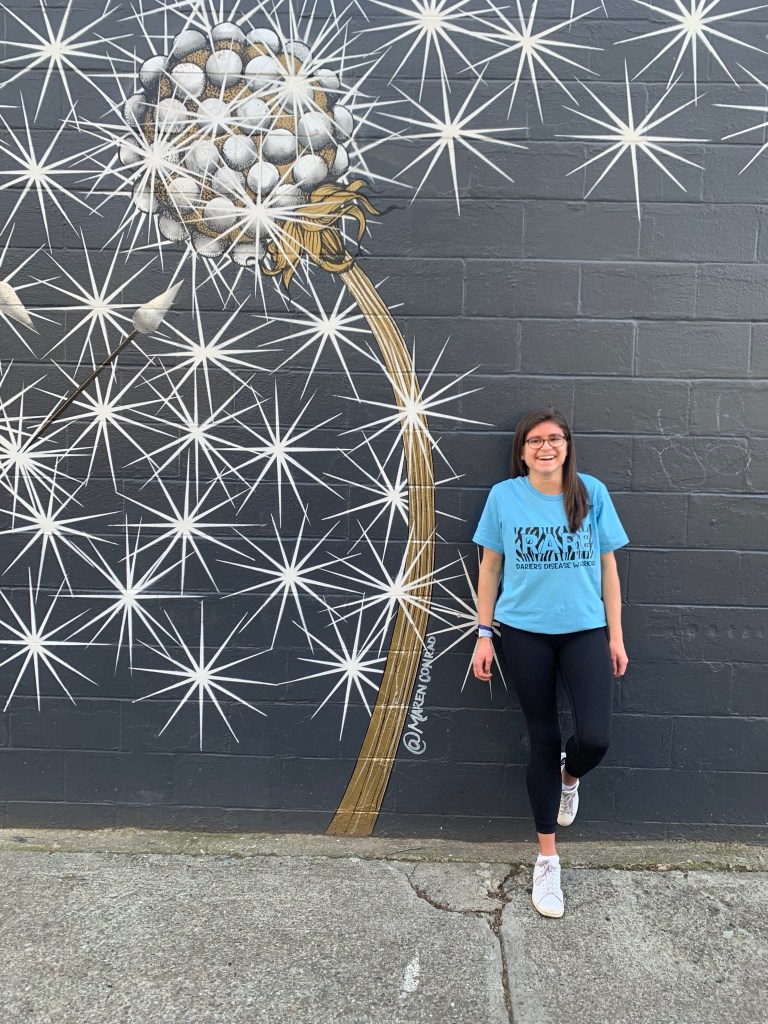
Decoding Darier’s addresses critical gaps in rare disease support: few opportunities for peer connection, insufficient advocacy, and limited patient-generated information. Genevieve’s vision was to provide a space where people with Darier’s disease could begin sharing stories: “Connecting in that way, and knowing other people understand, has been huge and empowering.”
The community allows people to share stories, trade information on therapies and interventions that have worked (or haven’t!) for them, and most importantly, make sure nobody feels alone on their journey. There’s even a running Instagram community group chat for people to participate.
“It’s validating to have that social-emotional support and share treatment routines, and to know that we go through the same struggles,” Genevieve says. “Even just the challenges of clothing and covering up, seeing some people say to wear what you want to wear has been impactful. I’m also grateful to help other people feel more comfortable. When people ask me how to make sure Darier’s doesn’t run their whole lives, I express that it’s about finding coping mechanisms, finding ways to keep it balanced, and finding community. Your community is the most important thing you can create. The more open you are with how you’re mentally or physically doing, the farther you can go.”
In the future, Genevieve hopes that Decoding Darier’s will expand into a larger community with a more global focus — and, in doing so, can begin collaborating with doctors and researchers to develop treatments and a deeper understanding of this disease.
“Right now, we don’t have the research,” she shares. “But the more we come together, the more we can advocate for patient-centric research. What is the emphasis on the patient side, not just the research side? How is this impacting patients? Yes, there are future generations so how do we make that better for them while also serving today’s patients?”
Right now, Genevieve herself is involved in research — or at least her cells are. A team at Northwestern has been researching her cells for years, trying to figure out how to replicate daily stressors to the petri dish. “So although research is happening,” she shares, “the pacing remains a challenge.”
Still, no matter what comes next, Genevieve knows one thing: that she will continue advocating for her community, and making connections, so people with Darier’s disease can feel heard.
 Rareatives
Leave a comment