
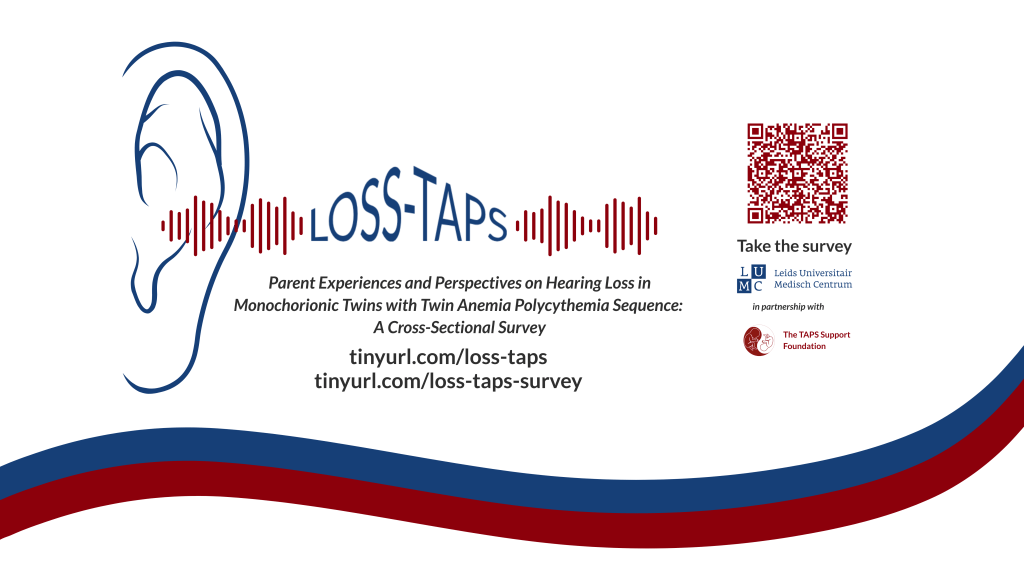
Through February 12th, the TAPS Support Foundation, in conjunction with the Leiden University Medical Center (LUMC) Fetal Therapy team, is running a cross-sectional survey designed to understand parent perspectives on hearing loss and deafness in children with twin anemia polycythemia sequence (TAPS).
A study published in Ultrasound in Obstetrics & Gynecology in January 2020 (first published August 2019) examined neurodevelopmental outcomes of 74 children born with TAPS: 34 donor twins and 40 recipient twins. The study found that 15% of donor twins had a form of bilateral deafness known as Auditory Neuropathy Spectrum Disorder (ANSD). According to the National Organization for Rare Disorders (NORD), ANSD is:
a sensorineural hearing loss that affects a person’s ability to hear or understand speech. Sensorineural means that this disorder is due to a lesion or defect in the inner ear, auditory nerve or the connection between the nerve and brain. As a result, sound enters through the ear but doesn’t get adequately transmitted to the brain.
Within the TAPS Support Foundation’s survey, parents can provide more insight into:
- The nature of this hearing loss
- When parents observed symptoms of hearing loss
- The diagnostic process
- ANSD treatment, management, and support
- The impact on children and families
In addition to collecting data that could be valuable to researchers in better understanding TAPS, the TAPS Support Foundation hopes that this study will bring more awareness to TAPS overall.
What is Twin Anemia Polycythemia Sequence (TAPS)?
According to the TAPS Support Foundation:
Twin Anemia Polycythemia Sequence, or TAPS as it’s better known, is a rare disease affecting twins sharing a placenta (monochorionic). TAPS in twins has many complications, including a high chance of neurodevelopmental impairment in donor twins, as well as deafness. There is also the potential for death and injury to babies from TAPS that is not diagnosed before birth.
In TAPS, the twins experience unbalanced blood flow due to minimal blood vessel connections between fetuses. When this occurs, one twin, known as the donor, loses blood to the other, known as the recipient. The donor twin then develops anemia, while the recipient develops a thick blood condition called polycythemia.
TAPS occurs spontaneously in 3-5% of monochorionic twin pregnancies, but may also result after laser surgery for twin-to-twin transfusion syndrome (TTTS).
There are several treatment options for TAPS, including:
(repeat) laser surgery, expectant management, early delivery, in-utero transfusions, and selective reduction.
The TAPS Support Foundation is currently looking to research to identify which treatment option is best for families.
Looking to help the TAPS community by sharing your story? Access the survey here.
For more information on TAPS, visit the TAPS Support Foundation website. If your twins have been diagnosed with TAPS, or if you’d like to learn more about it, connect with the TAPS Support Foundation on Facebook, X (formerly Twitter), or Instagram.

 Rareatives
Leave a comment