
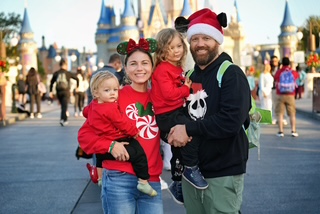
On the day Lowen was born, his older brother Knox picked up his guitar and sang him “Happy Birthday.” Knox, who is now three years old, has always been drawn to guitars and drums with an unshakeable enthusiasm.

Their parents, Liz and Todd, watched from across the room. They were thrilled to watch their sons already bonding, to see the love Knox already had for his younger brother. This small moment carried a weight that was hard to put into words.
When Knox was first diagnosed with spinal muscular atrophy (SMA), his parents didn’t know what would come next. And now they were waiting for the results of an expedited newborn screening panel — tests which would show that Lowen, too, had SMA.
For many families, a rare disease diagnosis can be scary — but more than that, it can sometimes feel like the center of gravity, the most defining aspect of a child or family’s story. But Liz doesn’t see it that way, because to her, spinal muscular atrophy (SMA) is not their whole story. In her interview with Rareatives, Liz discusses how community support helped them on their journey, her two thriving sons, and why it’s important to have hope.
The Initial SMA Diagnosis
Liz, a speech language pathologist and Todd, a Master Arborist and Urban Forester, had always known they wanted to start a family. Unfortunately, Liz experienced two miscarriages. But that didn’t stop the couple from moving forward. When Liz became pregnant with Knox, she was thrilled.
However, although Liz underwent several tests prior to and during her pregnancy, carrier testing was never really presented as necessary. Neither Liz or Todd had any family history of SMA. “Before we had Knox,” Liz says, “SMA was never on our radar.”
Even when she had Knox, her son appeared to be a healthy baby boy. It wasn’t until the results came back from Knox’s newborn screening panel that his SMA was discovered.
Newborn screening is performed 24-48 hours after birth and tests for a variety of congenital, genetic, and metabolic conditions. Not every state has standardized newborn screening panels. Indiana, for example, where Liz and Todd live, was the fourth state in the country to implement newborn screening for spinal muscular atrophy in 2018 (although, as of 2024, all 50 states have now implemented this!).
But, luckily for Liz and Todd, Knox’s SMA was identified early. As Liz says, “It was both shocking and incredibly fortunate at the same time.”
Liz still remembers the phone call she received from the front office staff at Knox’s pediatrician’s office. How the woman said, in a serious and shaking voice, that Knox had SMA. Someone from the local children’s hospital would be contacting the family soon. “I immediately fell to my knees and started to cry,” Liz shares.
What was SMA and what did that mean for her baby? Most doctors and geneticists will tell you the same thing after receiving a rare disease diagnosis: don’t Google the condition. Speak with your doctors first; speak with an advocacy group who has experience. There’s a lot of information which is outdated or poorly understood about rare conditions.
But Liz didn’t have that guidance yet, so she turned online. And what she saw scared her. She recalls, “I read things like my son may never walk, or that most children die before age two. I was in complete shock.”
Then a second call from a nurse liaison at Riley Children’s Hospital reoriented her outlook. “She told us there were three approved treatments and not to Google anything,” Liz says, “and then she immediately got us into neurology.”
What is Spinal Muscular Atrophy (SMA)?
Spinal muscular atrophy is a rare genetic disorder caused by SMN1 gene mutations. SMA is autosomal recessive, which means someone must inherit two mutated copies of the gene to develop this condition.
“This means both Todd and I are carriers. Each time Todd and I have a child, there is a 25% chance a baby will not be affected, 50% chance they will be a carrier and 25% chance they will have SMA. About 1 in 40 people are carriers,” Liz explains.
SMN1 gene mutations cause a deficiency of a protein called SMN. As Liz shares, “SMN is needed throughout the body, but motor neurons are most sensitive when the levels are low. Motor neurons depend heavily on that protein to survive. When levels are too low, this leads to motor neuron dysfunction and muscle atrophy over time. Once motor neurons start to die, there is currently no possibility of regaining function.”
Historically, SMA has been broken down into subtypes, from severe prenatal onset (type 0) and infantile onset (type 1) to intermediate, juvenile, or adult-onset (types 2, 3, and 4). However, shares Liz, “Typing is less relevant these days due to early treatment, often prior to symptoms.”
She explains that people with SMA also have varying copies of a backup gene called SMN2, with two to four copies being most common. Liz notes, “Two would mean symptoms would typically be more severe and four or more would be more mild. Each back up gene produces about 10 to 15 percent SMN. Both Knox and Lowen have 3 back up copies. Most of the time, siblings have the same copy number.”
Symptoms of SMA usually involve muscle weakness starting in the proximal muscles. Some children with SMA may also display poor feeding, developmental delays, or respiratory complications.
Treating SMA
Liz and Todd were told by their nurse liaison that there were three FDA-approved treatments for spinal muscular atrophy: Evrysdi, Zolgensma, and Spinraza. In fact, at the time of writing this story, a fourth option — Itvisma, for children ages two and older — was approved by the FDA in November 2025.
These treatments have been life-changing for the SMA community. Prior to treatment approval, SMA was considered the leading genetic cause of infant mortality.
Knox started Evrysdi, a systemic oral medication that boosts SMN2 output, when he was just nine days old. Although the family also wanted to start him on Zolgensma, a one-time gene therapy that delivers a working copy of SMN1 directly to the body, Liz explains, “He had high AAV9 antibodies — so high antibodies against the viral vector needed for gene therapy — so we had to wait for those to drop.”
Eventually, Knox received Zolgensma when he was four and a half months old, and has continued on Evrysdi ever since.
The Grief Journey
Although Liz and Todd received information from their doctors about Knox’s condition, fear persisted. “With rare conditions, there’s always a learning curve,” she says.
More than that, Liz describes her experience moving through the stages of grief while coming to terms with Knox’s diagnosis — a process that is not abnormal or uncommon in the rare disease community. In The Disorder Channel’s short film “Life After Diagnosis Day,” several rare families discuss how they grappled with the diagnoses they faced.
Thinking back, Liz remembers, “I went through days where I could not believe this was real. I’d wake up thinking it was all a dream and have a panic attack when I realized it was not. Denial, anger, depression, acceptance — it took about a year to reach acceptance.”
Nervous about questions or how she’d explain what was going on to others, Liz and Todd even originally decided not to share Knox’s diagnosis. Says Liz, “We did not tell people initially and that, paired with being in quarantine because of the gene therapy process, meant I did not deal with anxiety well. It’s been a long road with mental health, but both Todd and I have come a long way.”
Liz and Todd both leaned on their families for support, as well as did extensive research into SMA and advocacy groups. They joined Facebook groups for people with SMA and parents of children with SMA, finding comfort in connecting with the broader community, and connected with the family behind the Indiana Walk for Graham. It can be incredibly helpful to find and speak with others who recognize what you’re going through. Says Liz, “When you first receive a diagnosis like this, it can feel isolating. Hearing other families’ stories makes a difference.”
Liz also reached out to groups like Cure SMA, a nonprofit organization with a mission to drive research for treatments and a cure for SMA, and to the staff at Riley. “All of these people and groups have been crucial to our journey and building a care team we trust,” she shares.
If you are a parent of a child with a rare disease and are navigating your grief journey, Global Genes offers a “Guide to Grief” with several helpful resources. Give An Hour also offers free mental health support for rare disease caregivers.
Family Planning in the Rare Disease Space
As Knox grew older, Liz and Todd loved watching his interests and abilities blossom. He met (and exceeded) his gross motor milestones; he developed a fierce love of music, and an even fiercer love of all things Halloween.
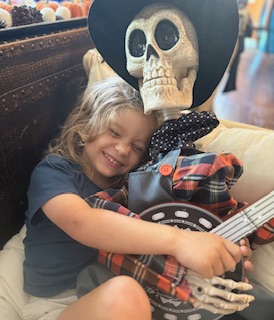
And as they watched Knox progress, both Liz and Todd began thinking about having another child, expanding their family and their love even farther. But this, of course, required considering what would happen if their second child also had SMA. Although IVF was an option, the parents eventually decided they did not have the bandwidth to go down that route.
“We knew there was a 25% chance and were okay with that decision,” says Liz. When Lowen was born with SMA, the family felt more prepared. “It did not make it any easier to find out had SMA, but we knew the journey and were confident with how he would progress since Knox has three copies and you’d never know he has SMA. We also knew Lowen had access to Evrysdi.”
Lowen started Evrysdi at four days old and received Zolgensma at two and a half months old. Similarly to his older brother, Lowen had to wait for his AAV9 antibodies to drop before he could receive treatment. Both boys have stayed on Evrysdi with phenomenal results.
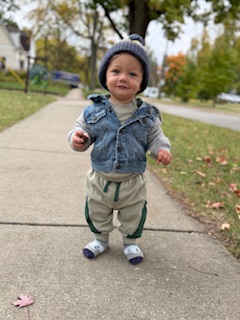
Lowen, it turns out, has never wondered what he is capable of. Instead, the sweet, easygoing boy, now one year old, has charged forward with an infectious zest for life. Liz describes Lowen as curious and inquisitive, motivated, and driven: “He started crawling at five months old, walking at eight and a half months old, and running shortly after. He’s also a climber and is constantly climbing on everything he can.”
And it was, in part, because of Knox himself, who had a way of making the future feel less frightening for his brother and parents simply by living in it so fully.

To Liz, early diagnosis and treatment are a crucial part of how her sons have thrived and continue to thrive. And she feels incredibly grateful for the treatments available to her.
“It has not gotten past me that out of over 7,000 rare genetic diseases, only around 5% have FDA-approved treatments,” says Liz. “Treatment has completely changed our lives and the trajectory of my sons’ lives. We are truly fortunate to have access and approval to both medications.”
That said, Liz hopes that, in the future, there will be more research into continued treatment advances, as well as long-term outcomes. Although she notes that the progress in SMA research is remarkable, continued innovation — especially in spaces like nerve function regeneration, dual therapy, or gene-editing — is incredibly important.
Parenting Rare
As a mother, Liz never wanted her children to feel limited — and she didn’t want anyone else to judge them based on perceived limitations either. This is one of the reasons she chose not to share their diagnosis for so long, because she feared that people wouldn’t recognize what her children can achieve.
“Our kids are our kids. They are not defined by or limited by their diagnosis,” Liz emphasizes. “SMA is part of our story, but it’s not the whole story.”
Her sons are bright, bubbly, and occasionally boisterous. Knox is currently captivated by Transformers, and Lowen by developing an even stronger bond with his older brother. They love spending time together and creating sweet memories.
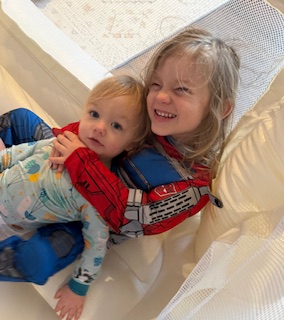
Together, the family loves exploring local playgrounds and farmer’s markets, or traveling together. To Liz, this exemplifies that SMA is not a factor that is restricting their life, but just an added factor to consider. “Our boys have taught us resilience and perspective in ways we never expected,” she says.
She recognizes that many people have never had experience with spinal muscular atrophy or, if they have, don’t have a huge depth of knowledge into what SMA is or how it impacts families. As such, Liz encourages people to reach out and try to learn, saying, “It is so important to show up for parents and families going through these rare conditions, because it’s always rare until it happens to you. Taking the time to learn about a condition makes a world of difference to us. We just want to feel understood on our journey.”

By sharing her story, Liz hopes to remind other parents in the SMA community that they are not alone and that there is hope for a better future. If you’re struggling, Liz says, just remember to “take it one step at a time. You don’t have to figure everything out immediately. There is real hope today, and your child is still your child first. Do not let those early diagnosis days steal your joy as a parent.”
If your child has been diagnosed with spinal muscular atrophy, or you’d like to learn more about SMA, visit Cure SMA.
 Rareatives
Leave a comment