
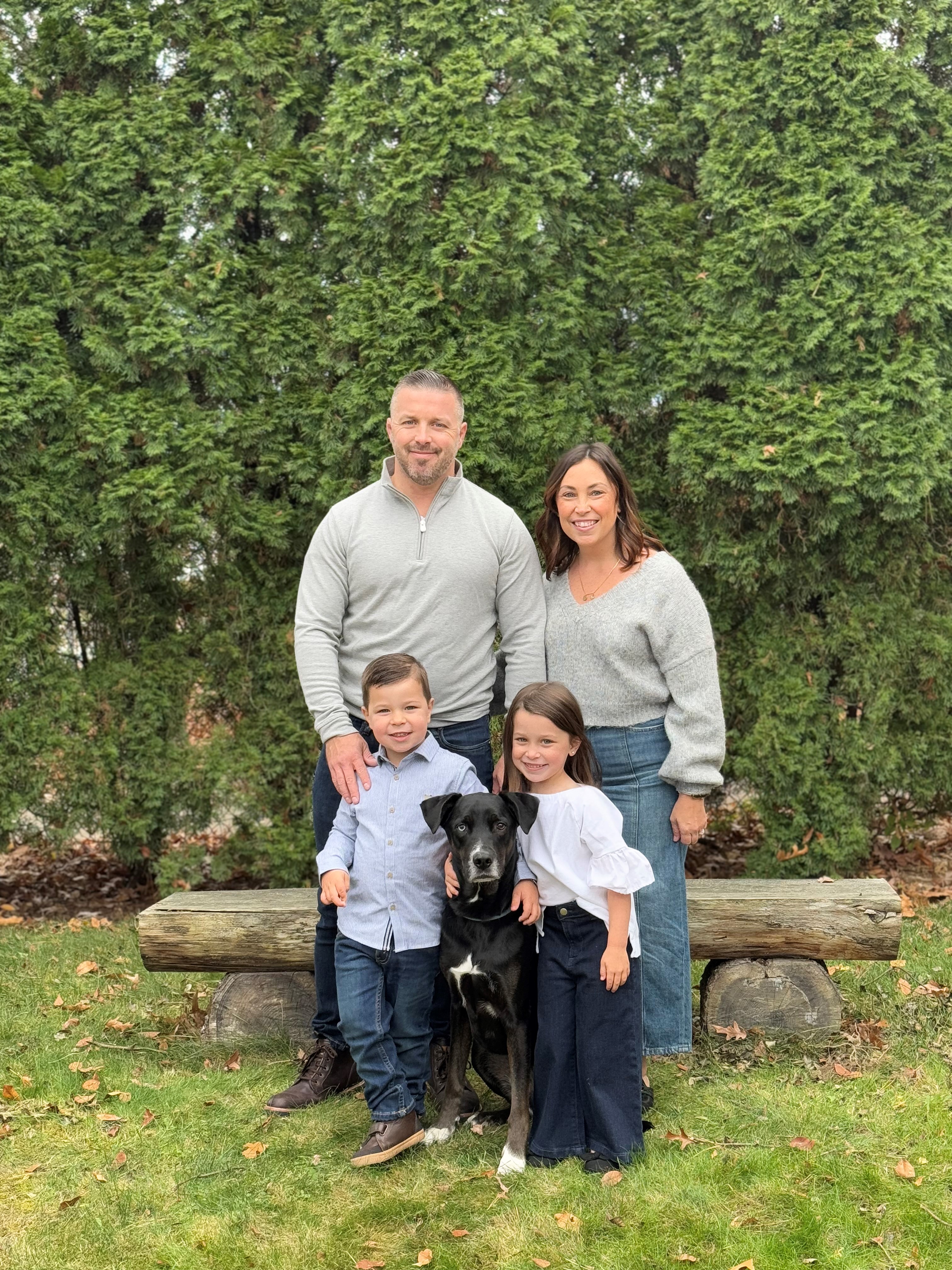
In a quiet corner of Kristina and Paul’s Norwood, Massachusetts home, a linen closet tells the story of how quickly life can change. Organized rows of medical supplies now fill the shelves where towels and bedsheets once sat. Sharp disposal containers and injection equipment occupy every available space.
The transformation began over three years ago when Kristina and Paul noticed dark bruising on their then ten-month-old son Axel’s knee, thigh, and arm. Concerned, the parents took Axel to the emergency room.
“And from there, everything went pretty quickly,” Kristina says. “By 8am the next morning, we were in the hematology department at Mass General. 24 hours after that, the bloodwork results came back with a definitive diagnosis of severe hemophilia A.”
Nobody in their family had any history of hemophilia, prompting questions about whether Axel’s condition resulted from a spontaneous gene mutation. But Kristina was shocked to learn that she carried the gene — and that, eight months later, her daughter Daisy would also receive a definitive diagnosis (though Daisy’s hemophilia A is classified as mild).

“There’s a huge myth about women not having hemophilia. In the last year, we’ve learned that more than ever. Daisy has had to have endoscopies and we’ve learned very quickly that, even though her levels are in the ‘mild’ range, she can’t undergo procedures without medication to prevent bleeding events,” Kristina explains.
In sharing her family’s story with Rareatives, Kristina hopes not only to raise awareness around hemophilia A, but to encourage those traditionally discounted in the bleeding disorder space to be stronger advocates for themselves.
Developing a Treatment Plan
After Axel’s diagnosis, and considering the severity of his bruising, doctors quickly moved to establish a treatment plan. Kristina admits that the process was “slightly overwhelming, but doctors gave us lots of information and options.”
The family chose Hemlibra, a medication used for routine prophylaxis to prevent or reduce the frequency of bleeding episodes in adults and children with hemophilia A. Hemlibra allows Axel to receive injections every other Saturday, rather than the once-a-day infusions that previous generations of people with hemophilia had to endure.
“Where we’re at today is amazing, especially in comparison to only ten years ago,” Kristina notes. “Hemlibra didn’t even exist until seven years ago. I hope, in the future, research and treatments continue to trend in that direction.”
Still, challenges abounded. The medical world that the family entered came with its own vocabulary and rules. Axel’s diagnosis meant mastering injection techniques (hard when you’re injecting a little baby!), learning to spot internal bleeds that could damage his joints, and memorizing treatment protocols. Visiting nurses helped, but Kristina needed to learn to manage these treatments herself.
Finding Community
As Kristina’s knowledge around hemophilia A grew, she still lacked the support and insights that a strong community foundation could provide. But she felt uncomfortable reaching out to organizations like the New England Hemophilia Association (NEHA) at first, hoping she’d figure it out on her own.
With a small laugh, she says, “I quickly learned that hemophilia A is very rare and I needed help. I reached out and it was incredible. NEHA was so warm, welcoming, and happy to educate us on anything we needed.”
When Axel’s port surgery failed and he spent five days in the ICU, NEHA was there for the family through all of it. “Axel had only been diagnosed a month prior,” Kristina shares, “but NEHA was sending me advice, messages of support, and even teaching me how to medicate him once he came home. It was amazing seeing this community of people so willing to help a complete stranger.”
NEHA’s outreach compelled Kristina to give back to the organization through volunteerism and fundraising for the annual Unite Walk. According to NEHA, the Unite Walk:
“allows us to celebrate the resilience, dedication and perseverance of our Wicked Strong Family! This important event also raises vital funds needed to continue providing education, support and advocacy for the New England bleeding disorders community.”
While fundraising for the walk, Kristina launched an Instagram page (@the.axe.factor) documenting Axel’s life with severe hemophilia A. Somewhat unexpectedly, her posts drew messages from other parents across the country facing new hemophilia diagnoses.

“People were reaching out wanting to ask me questions,” she explains, “but I also wanted to spread the word about what hemophilia A is. Any type of awareness is huge. Axel doesn’t have a classroom of kids dealing with the same thing as him. He may not have another friend, outside of who we’ve met in this community, living with hemophilia. My goal is to get as many eyes and ears on this as possible in hopes that research and funding go further. People don’t know what they don’t know, but if we don’t share and open their eyes, things won’t go anywhere.”
To parents whose children are newly diagnosed with hemophilia, Kristina has two crucial pieces of advice. The first is to know the parameters of treatment. She explains, “If an EMT had to come to my house, they wouldn’t know how to put Axel’s medication together. I get it, because the medication is rare, but as a parent, you need to know how to do those things.”
The second piece of advice — to find a community, even if it’s small — reflects Kristina’s own experiences. “I never thought I’d be that person who would talk to strangers about my child’s health,” she says, “but having someone who actually knows what you’re talking about and can advise you appropriately has been super helpful.”
“You Would Never Guess…”
Now, at four years old, Axel races around his pre-K classroom. He’s vivacious and lively — and makes friends wherever he goes. Axel even began playing soccer in the fall, a sport he can’t wait to continue. As Kristina says, “If you didn’t know he has hemophilia, you would never guess.”

Of course, soccer requires a certain level of vigilance. “One myth about hemophilia is that you’ll bleed to death with a papercut,” Kristina shares. “Not true. People with hemophilia bleed longer, not faster. But internal bleeds, like ankle or knee bleeds, are a concern if he’s playing sports and overexerting his joints. With Hemlibra, our days are mostly typical except the mental load of injury or fall concerns.”
Axel understands hemophilia at a four-year-old’s level — that he has a bleeding disorder and needs his medication to keep his body safe. While “clotting” might be over his head, Kristina explains that the family frames his treatment positively: “If you want to play sports or play at recess, your medicine lets you do that.” He’s also learned to recognize serious falls, knowing when a hospital visit might be necessary.
In the future, Kristina believes that gene therapy might advance far enough that hemophilia can be cured. But until then, she’ll continue ensuring that Axel has access to Hemlibra.
Sometimes that requires some fierce advocating. When Axel’s temperature-sensitive medicine sat in a freezing delivery truck over a winter weekend, pharmacy representatives insisted the medication remained safe for use.
“I was horrified,” Kristina recalls. “It specifically says ‘do not freeze’ on the package, and was stored on one of the coldest weekends of the year. How do I trust they took it off the truck, or that it didn’t freeze and thaw?”
It took fifteen calls and multiple doctor interventions before the pharmacy agreed to replace the compromised $13,000 vial. This battle, and others with insurance, taught Kristina that families in the rare disease space must know their conditions better than anyone else.
*The cost of medicines for people with hemophilia A can be highly variable depending on a number of factors, including disease severity, weight and different dosing for prophylaxis vs. episodic treatment.
“You have to be fierce and strong and adamant, and you have to educate yourself,” Kristina says.
Challenging Medical Assumptions
Kristina’s advocacy also extends into the female bleeding disorders space, which is both poorly understood and undertreated. When emergency room doctors see a female patient with excessive bleeding, they may not consider hemophilia as a possibility. When female patients visit doctors to complain about heavy, long-lasting menstrual cycles, they’re often dismissed.
For Kristina, six-year-old Daisy’s mild hemophilia diagnosis has exposed some of these critical gaps. “I’m really surprised at some of the reminders I’ve needed of what we have to do for Daisy before procedures,” she says, “and I’m her mother. What would have happened if we didn’t have a great team of doctors that took this seriously? What happens to the women with bleeding disorders who don’t have that?”
To get more attention in the bleeding disorder space, women need to firmly advocate for themselves. It is highly recommended to seek a doctor’s opinion if you’re experiencing symptoms such as:
- Easy bruising
- Full, heavy menstrual cycles that last longer than a week
- Large clots passed during menstrual cycle
- Unexplained nosebleeds and/or nosebleeds lasting longer than 10 minutes
Says Kristina, “I’ve met women in the bleeding disorder community who have menstrual cycles lasting fifteen days. Doctors say that’s unfortunate, but it’s not realistic. Had these women seen a hematologist, they might’ve seen that a cycle like that isn’t just part of being a woman but could be part of something like hemophilia or von Willebrand disease. Doctors need to be more willing to hear patients all the way out. These women who end up anemic whenever they have a cycle, that’s not normal.”
In Daisy’s case, doctors plan on keeping an eye on her health, especially through puberty, and adjusting treatment as needed in the future. And with awareness, Kristina hopes that other families can find the same level of care.
“Hemophilia might always be more of a man’s disease than a woman’s,” she says, “but we need to fix the fact that it is hugely underdiagnosed in women.”
***
If you would like to connect with Kristina, you may do so on The Axe Factor. You may also consider making a donation to NEHA to support their important work.




Leave a Reply