

The sound of Malani’s laughter fills the air as she bounces on her trampoline. Soon, she’ll climb down for a movie night with her family, including mom Emily and siblings Kelvin, Jalen, and Makayla. Malani might be the youngest in the family. But she admittedly has the most sway when it comes to movie choices: the familiar favorite of Frozen, Sing, or Trolls.
When you look at Malani, you see a vivacious, silly young girl with an infectious smile. A girl who loves music and dancing, food and car rides, and being around people (although she wouldn’t miss car rides if she never had to take them again. “She’s the light of our lives,” Emily says.
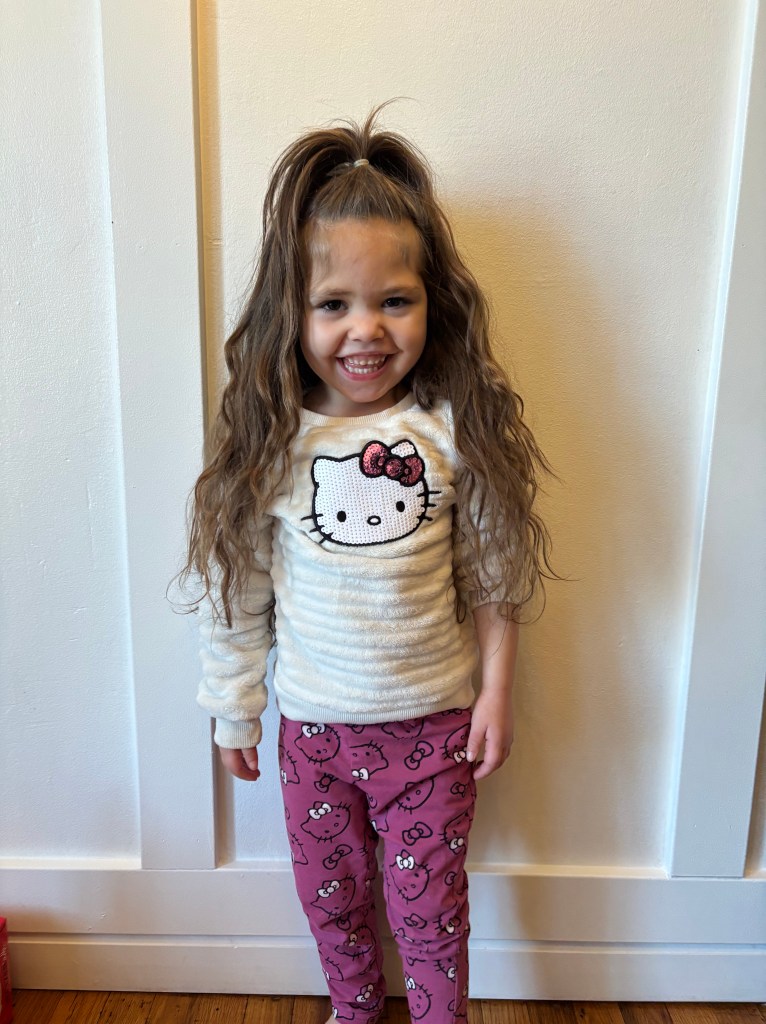
But Malani and her family grapple with the daily challenges associated with her ultra-rare condition, known as Beta-propeller Protein-Associated Neurodegeneration (BPAN). There is currently no cure for BPAN.
By sharing Malani’s story, Emily hopes not only to bring valuable awareness and understanding about BPAN to the forefront of conversation, but to spur a push for fundraising.
“Please donate if you can,” she pleads, “but any conversation you have, with friends, family, or community, is a step in the right direction. Our children are on a timeline and we truly need every ounce of help.”
A Mother’s Intuition
By the time Emily was pregnant with Malani, she had already birthed two children. She knew what raising a child looked like. What the milestones they should hit should be.
But something about Malani’s development felt off, even though Emily couldn’t quite put her finger on it. “She was always just slightly behind,” she tells me. “I had a gut feeling something was wrong. But I don’t think doctors took me seriously at all.”
Doctors would wave their hands and dismiss Emily’s concerns with platitudes familiar to many parents of children with rare disorders: “She’ll catch up soon.” “Every kid is different.” “Maybe you baby her too much.”
Then, around the time Malani turned one year old, the seizures began. And once again, doctors seemed dismissive of Emily’s concerns. “We were told they were febrile,” she recounts. “That the seizures would never happen again.”
This time, Emily and her husband refused to back down. They told doctors that Malani needed an electroencephalogram (EEG), which tests and detects abnormal brain waves. The first EEG took just twenty minutes. But Malani was pulling at the wires on her head — and, unsurprisingly, the test showed no seizure activity.
Still, at home, Malani experienced multiple seizures over the next year. After having two frightening back-to-back episodes, Emily’s persistence brought the family to another hospital. Malani was admitted for a four-day EEG.
Finally, the family got at least some answers.
Next Step: Genetic Testing
Malani’s EEG proved that Emily had been right to be concerned all along. Her brain was “constantly spiking,” leading to near-continuous mini-seizures throughout the day and night.
Seizures that, despite Emily’s attempts to get doctors to listen, had been missed.
Malani was diagnosed with epilepsy and started on medication. Physicians then suggested genetic testing, which might give the family any genetic underpinnings causing Malani’s seizures.
What genetic testing found was both surprising and entirely unexpected. On May 18, 2023, the neurologist told Emily that her daughter had been diagnosed with Beta-propeller Protein-Associated Neurodegeneration (BPAN), an ultra-rare genetic disorder affecting fewer than 500 people worldwide.
When our doctor gives us bad, concerning, or hard-to-understand news, we often expect that they’ll sit there and explain it to us. Explain what to do, how to move on, how to treat it — anything.
But all the neurologist could do for Emily was hand her some printed pages from the Children’s Hospital of Philadelphia (CHOP)’s Clinic for BPAN and WDR45-related Disorders. “She couldn’t tell us anything about the disorder; she had never heard of it before,” Emily says.
Emily was told to make an appointment with CHOP as soon as possible and to not Google anything.
Says Emily, “Obviously, I Googled.”
What is BPAN?
BPAN, a condition only officially identified in 2012, belongs to a group of disorders called Neurodegeneration with Brain Iron Accumulation (NBIA). As the NBIA Disorders Association explains, NBIA is:
“A group of rare, genetic neurological disorders characterized by abnormal accumulation of iron in the basal ganglia…a collection of structures deep within the base of the brain that assist in regulating movement. Although we all normally have iron in this area, people with NBIA have extra iron that can be seen on MRI.”
Emily continued consuming everything she could find online: a Facebook group, available research, NBIA Disorders Association resources. When she showed up to her CHOP appointment, she was going to be prepared with a notebook full of questions and articles.
Understanding BPAN
As the iron accumulates in the brain, progressive brain damage occurs. This neurodegenerative disorder, as Emily discovered through her research, is complex. BPAN manifests differently in each child, making it challenging to predict or prepare for. Emily explains, “There’s no way to know how fast or slow it will move.”
BPAN is caused by WDR45 gene mutations on the X chromosome. Most people with BPAN are the first in their family to have this disorder, and those affected are typically female. Since BPAN was discovered, it has become the most prevalent NBIA disorder, accounting for an estimated 35-45% of the NBIA community.
“Many children have been misdiagnosed,” Emily says. “More children have this than we think.”
BPAN, like in Malani’s case, is characterized by recurrent seizures in infancy or early childhood. Many children might have febrile seizures, as well as absence, atonic, tonic-clonic, or grand mal seizures. BPAN also causes physical and developmental delays, such as:
- Ataxia (difficulty coordinating movements)
- Feeding difficulties
- Teeth-grinding
- Sleep disturbances
- Issues with expressive language (speech, vocabulary)
As BPAN progresses, Emily explains that “those affected develop dementia, movement disorders like dystonia, and Parkinsonism. They will lose their ability to walk, talk, eat, or do anything independently.”
Life expectancy with BPAN is unpredictable. Most individuals with BPAN live into early adulthood; some reach middle age. But more research, treatment options, and a potential cure could be absolutely life-changing. Says Emily, “I’d love to see more studies around gene therapy.”
Living Life on the Edge
When your child has an ultra-rare disorder, you never know what every day will bring. Since Malani’s immune system is weakened, even mild illnesses land her a hospital visit. Even the slightest fever can lead to a seizure; Emily carries her medical bag every time they leave the house, just to be prepared.
At the same time, managing BPAN requires a rhythm and a routine. Malani begins her day with breakfast and her first dose of Keppra, an anti-seizure medication. After attending preschool from 9am-2pm, where she receives various therapies, she returns home for a snack before diving into additional therapeutic interventions:
- Speech therapy
- Music therapy
- Hippotherapy (therapeutic horseback riding)
On days without therapy, Malani attends her siblings’ events or sports games, ever the loving sister. Evening brings dinner and bath time, followed by Keppra and Clonidine to help her wind down.

But even with medication, restful nights can be hard to find. Malani wakes up anywhere between one and four times throughout the night.
For some families, getting physicians to address medicinal needs or sleep support is a battle. Emily shares, “Witnessing our children struggle breaks my heart. It has also opened my eyes to the financial difficulties that families dealing with rare diseases face, especially with insurance. It shouldn’t be this complex to secure the essential care our children need to survive.”
Addressing Other Challenges
Oftentimes, to this day, Emily feels like her family’s concerns about Malani remain poorly addressed by doctors. “Some medical professionals see that Malani ‘looks’ so normal that they overlook her needs or don’t take what we’re asking seriously,” Emily says with a sigh. “I wish they would take the time to learn about rare diseases and listen to the parents when we know something isn’t right, rather than making us fight for every little thing.”
For example, Malani can walk and is mobile, but struggles with stairs, steps, and uneven surfaces due to hypotonia (low muscle tone) and core weakness. She still struggles with seizures, and her eyesight is poor — she’ll start wearing glasses soon. And she has trouble following commands or doing tasks independently.
Perhaps the most challenging aspect is the communication barrier. Malani is nonverbal with “very minimal language,” meaning she cannot always express her needs, wants, or feelings. This limitation can lead to intense blowups.
Emily explains, “She gets frustrated very easily which can lead to self-harm, like banging her head or punching, yelling, and screaming. It’s a constant battle to try and figure out what she’s feeling.”
At the same time, Emily believes it’s important to educate others on being nonverbal. One persistent myth about being nonverbal is that a nonverbal individual is not intelligent. Let’s be clear here: this is absolutely and unequivocally FALSE. Someone being nonverbal has no relation to their intelligence or self-worth; it only has to do with the way they communicate.
As Emily describes it, “Being nonverbal doesn’t mean non-understanding, or that our lives are lacking in any way. Children with BPAN, like anyone else, deserve to be included. As parents, we crave that inclusion as well. People tend to either apologize for our situation or simply exclude us from activities. But all individuals with rare conditions and parents of these children desire to be treated with normalcy. While our lives may differ from the typical experience, they are still rich and fulfilling. This is our version of normal. We embrace it.”
Navigating Life as a Rare Parent
When she was pregnant with Malani, Emily never expected to be in this position. With no previous experience in her family with disabilities or chronic illnesses, the learning curve has been steep.
Emily admits, “I never anticipated parenting a child with such challenges. But having a child with a rare disorder has entirely changed my perspective on life. I wouldn’t trade Malani for anything. Her courage, strength, and inspiring spirit have taught me to live in the present, appreciating and cherishing all the small things. I’ve discovered a resilience I never knew I had, and endless amounts of love. It has made me find beauty in the toughest situations. I am just so thankful for my daughter. We will never let this disease define us.”
To cultivate community, and share BPAN information, Emily started Malani’s Mission on Facebook and Instagram. She originally created the page following Malani’s diagnosis, responding to the void she had encountered in her own search for knowledge.
“I felt completely lost,” she remembers. “I didn’t know where to turn or what resources were available. As I researched, I was surprised by how little information there was. My goal is not only to raise awareness but to support other parents on similar journeys through encouragement and guidance. We are a small but mighty community full of parents who just want the best for our children.”
Offering Advice (and A Request)
To parents, Malani’s Mission stands as a reminder that they are not alone in this fight. And that life isn’t over, either.
“I know receiving this diagnosis is earth-shattering. This process won’t be easy, but it’ll be worth it. Each of our children is so unique. No one knows what the future will hold, though, so don’t waste your time trying to figure it out. You will miss out on so much good right in front of you,” Emily says.
She continues, “Start therapy early. Find doctors who listen and fight for your child. If something doesn’t feel right, and the odds are that it isn’t right, nobody will advocate for your child like you. But you ned to take care of yourself too. Take breaks when you need. There’s nothing wrong with asking for help. This might not be the life you envisioned, but it’s exactly where we’re meant to be. We are the lucky ones to be given the gift of raising these special children.”

As she works to empower parents, Emily also staunchly pushes forward in her critical goal of generating support for desperately-needed research that could one day lead to a cure. As it stands now, BPAN remains poorly understood. But research requires funding that can be hard to come by.
Emily shares, “Almost all funding is done by parents and private companies, which impacts the pace of research.”
For Emily, advocacy is about helping her daughter, but it’s also about more than that. In the rare disease community, we live by the knowledge that we are stronger together.
Every day, every moment, Emily will continue on to ensure that her daughter, and every other child with a rare condition, is seen not for their challenges but for their joy. For what they bring to the world by just being in it. And for what we can do collectively to continue that joy.
To learn more about BPAN and support families like Malani’s:
- Follow Malani’s journey on Instagram and Facebook: @malanis.mission
- Visit the Children’s Hospital of Philadelphia’s resource page on WDR45-Related Disorders and BPAN
- Learn about related conditions through the NBIA Disorders Association.
- Donate to Malani’s Mission to pave the way for groundbreaking BPAN research.

 Rareatives
Leave a comment