
Many people in the rare disease community have faced the diagnostic odyssey. According to a survey from EURODIS-Rare Diseases Europe, people living with a rare disease face, on average, a 4.7-year diagnostic delay between when symptoms first appear and when a diagnosis is found. In newborns who present with symptoms of a rare condition, that diagnostic delay sits around 4.9 years.
But for parents like Maria, finding an answer is of the utmost importance. Despite prenatal testing showing that her son Daniel would be born with several anomalous findings, Maria has waited for three years without answers. Three years without having a name for what her son is dealing with. Three years with no promising treatment options or known patient community to lean on.
“I feel like I’ve been on this road for about twenty years,” Maria tells me. “I feel like no matter how hard we push, we’re getting nowhere.”
That’s not to say Maria hasn’t tried. She has pursued every test she can possibly find. Gone down every road doctors can think of. Yet even comprehensive genetic sequencing has not yet returned with any promising results. “I’m 90% sure that, after they didn’t find anything on our latest test, his case is going to be closed and then retested in a few years,” says Maria with a sigh. “It’s a bummer, but it is what it is. We don’t know what else to do.”

In sharing Daniel’s story, and her family’s experience, Maria hopes that some details will resonate with someone—a doctor, a geneticist, another family. Someone out there who recognizes these symptoms and can potentially offer help. And Maria is equally interested in any research opportunities. If you would like to connect with Maria, please contact jessica.lynn@rareatives.com and she would be happy to facilitate that introduction.
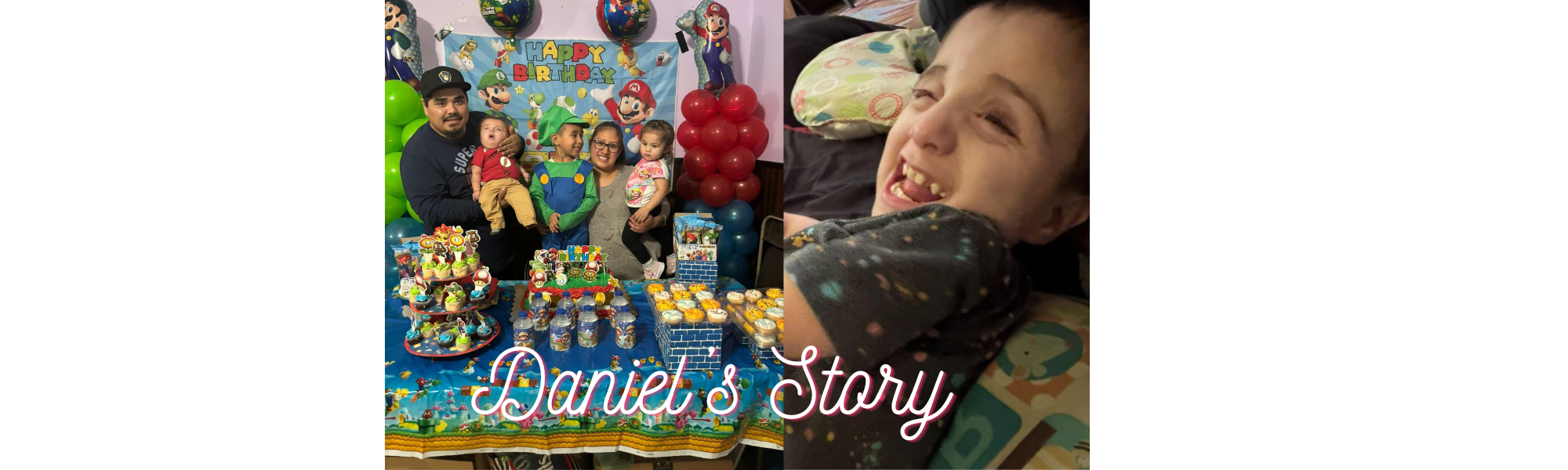
Daniel’s Story
A majority of Maria’s pregnancy was relatively easy. She had been pregnant before—first with her oldest son, then with her daughter—so she knew what to expect. When her daughter was born, she weighed just five pounds. So, when Maria was 32 weeks pregnant with Daniel, the doctors suggested an ultrasound to see whether Daniel was developing properly. If, for whatever reason, he also looked small like his sister had been, they could figure out a path forward.
But the ultrasound technician noticed some other potential complications. Says Maria, “His hairline was almost down to his eyebrows. He had abdominal ascites, or fluid in his stomach, and no toenails.” In addition to facial deformities and his hip being out of socket, Daniel’s size was also not proportional to a 32-week fetus.
Maria immediately started to panic. Her doctors were also worried, placing her under threatened pregnancy protocol. For the next five weeks, until she was induced at 37 weeks, Maria saw specialist after specialist. When Daniel was born, he spent the first one and a half months of his life in the NICU.
“Nobody could understand what happened,” Maria shares. “Somewhere between my scan at week 28 and week 32, these changes all began to appear. While he was in the NICU, doctors ran several tests to understand why we didn’t see any of this before. My husband and I also underwent genetic testing. But the tests came back, for both us and Daniel, with no findings.”
Searching for Answers
After being released from the NICU, Daniel went home to his family. He has spent the last three years under the care of Children’s Wisconsin. Maria explains that her son sees nearly every specialist in the hospital, from dermatology and genetics, and is under the care of a complex care team.

“He’s been admitted probably 90% of his life. His longest time in the hospital was 64 days. Usually, when he’s admitted, it’s for two weeks or a month at a time,” says Maria.
Doctors have tested for muscular dystrophies, Down syndrome, and genetic conditions. Maria and her husband had their family undergo testing, as well as their other two children. Once again, each test has come back without any clues as to what the family is facing.
His symptoms and manifestations of his undiagnosed condition are extensive. While he has been under care, his doctors have taken his case to other medical hubs around the country—from North Carolina to New York. “I’ve heard doctors say so many times, ‘We have never met someone like Daniel.’ It’s a lot,” says Maria. But, she adds, “I feel like, as a mother, there is probably someone out there whose experience is close to Daniel’s. That’s why I’ve been trying to get his story out there. Maybe he’s one in a million. Maybe there’s nobody else like him in the world. But I have to try.”
About Daniel
Daniel is extremely small in stature, with his mom describing him as looking “around one year to eighteen months old in size. He’s grown in length, but not in endurance. We are working so hard on sitting up,” a milestone complicated by his hypotonia (low muscle tone). Right now, because Daniel is so small and thin, he receives nutrition through continuous G-tube feeding for around 22 hours each day. He’s also in physical and occupational therapy.
Additionally, Daniel deals with osteopenia, or low bone density. While many people develop osteopenia as they age, Daniel has a congenital form, which means it has been present since birth. His bones aren’t as strong or dense as they should be. As a result, he’s had at least six fractures.
Daniel has had multiple biopsies, as well as surgeries for his ears, eyes, and nose. Fluid builds up quickly in his ears. Despite having tubes placed to help the fluid drain, Daniel must undergo surgery every six months to remove the trapped fluid. However, these surgeries are complicated by his platelet dysfunction.
“Usually, this type of platelet dysfunction is only seen in older children,” Maria explains. “But it requires him to get platelet transfusions before every surgery. Sometimes, his platelet dysfunction and bleeding disorder also causes the surgeries to not recover well, leading to additional bleeding.”
His immune function waxes and wanes, with Maria noting that he is extremely sensitive to viral illnesses and bacteria. While getting sick is inconvenient for most people, these illnesses would likely send Daniel to the hospital.
Finally, Daniel is also extremely sensitive to light—“We have to dim the house at home, and we have specialized blackout sunglasses for him whenever he has to leave the house,” Maria says”—and struggles with temperature regulation. Maria’s husband usually takes their other two children to the park while Maria stays home with Daniel, since he cannot handle the fluctuating weather. They also must keep their home consistently cold.
“So winter is our favorite season,” she says.
Navigating an Undiagnosed Condition
Unfortunately, handling an undiagnosed rare condition is extremely challenging in multiple ways. It’s often costly, requiring repeated tests and doctor visits. It is strenuous on parents and caregivers, who often find themselves at a loss on how to move forward. Families often face isolation as they prioritize, as they must, their child’s care. Rare diseases themselves can be exhausting, but remaining undiagnosed adds an added mental and emotional tax.
In Maria’s case, she questions how they can keep looking for answers given the undue financial and familial burden. “We have two other kids we need to take care of as well,” she says. “Moving would be hard. To be honest, I have no idea how I make it happen caring for everyone as is. Everything I do and think, I just put it in God’s hands and let Him lead. I ask him to give me the strength to make me strong mentally. I have programmed myself to just trust God and Daniel’s team.”

When Daniel is hospitalized, Maria spends 24 hours a day at the hospital with him. She stresses that his condition is so tenuous that he can go from being healthy at noon to being in hypovolemic shock by 3 p.m. “We’re always at the end of the bridge, going back and forth. Is today going to be a good day? Is he going to have a good night?” she says.
The psychological stresses associated with an undiagnosed condition are also intensified by the general lack of community. Says Maria, “I just want to talk to people who understand what I’m going through. I want to ask how they handled these things.”
If you, like Maria, are a parent of a child with an undiagnosed condition, or are undiagnosed yourself, here are some resources to help:
- Undiagnosed Diseases Network Foundation (UDNF): The UDNF is a patient-driven nonprofit fostering community, support, innovation, and action for families navigating the uncertainty of rare and undiagnosed diseases. They offer social groups and resources to help undiagnosed families and individuals find community.
- Undiagnosed Diseases Network: UDN is a research study funded by the National Institutes of Health. Its purpose is to bring together clinical and research experts from across the United States to solve the most challenging medical mysteries using advanced technologies.
- Rare and Undiagnosed Network (RUN): This group of advocates, patients, families, and researchers is working to bring more testing into clinical practice and support undiagnosed individuals and families.
The National Organization for Rare Disorders also has additional resources for families and people with undiagnosed medical conditions.
Daniel Today
When Maria imagines the future for Daniel, she imagines answers. Treatment. Care for her son beyond what is offered now. She wants to know that he’ll get the love and support he deserves. And she imagines more understanding from the broader community.

“Have empathy for children who aren’t able to do things like other kids,” she says, “and educate your children so they have empathy. For a long time, my kids asked me why Daniel couldn’t sit or stand, or why he’s not growing. And I think they understand more, now, and I want to see that in others.”
Until then, she’ll never stop fighting to understand what is going on with her fun, bubbly son. She describes him, when he’s not sick, as easygoing and patient. He doesn’t know how to talk yet, but he enjoys playing with his toys and rattles. So she’ll share his story. She’ll ask for more tests — “I am always asking his team, what else can we do? They say there’s no more tests. But some day there might be a yes. Some day we might find a community, someone out there the research hasn’t gotten to yet. Some day we will be okay.”
And for parents, especially those of you who are navigating a similarly tough landscape, who for some days the obstacles seem insurmountable, Maria reminds you that you are not alone. She says, “If you’re a mother to a child like Daniel, don’t give up. Always advocate for your child, no matter where you have to go or what you have to do. Never lose hope and faith that things will get better.”


Leave a Reply