
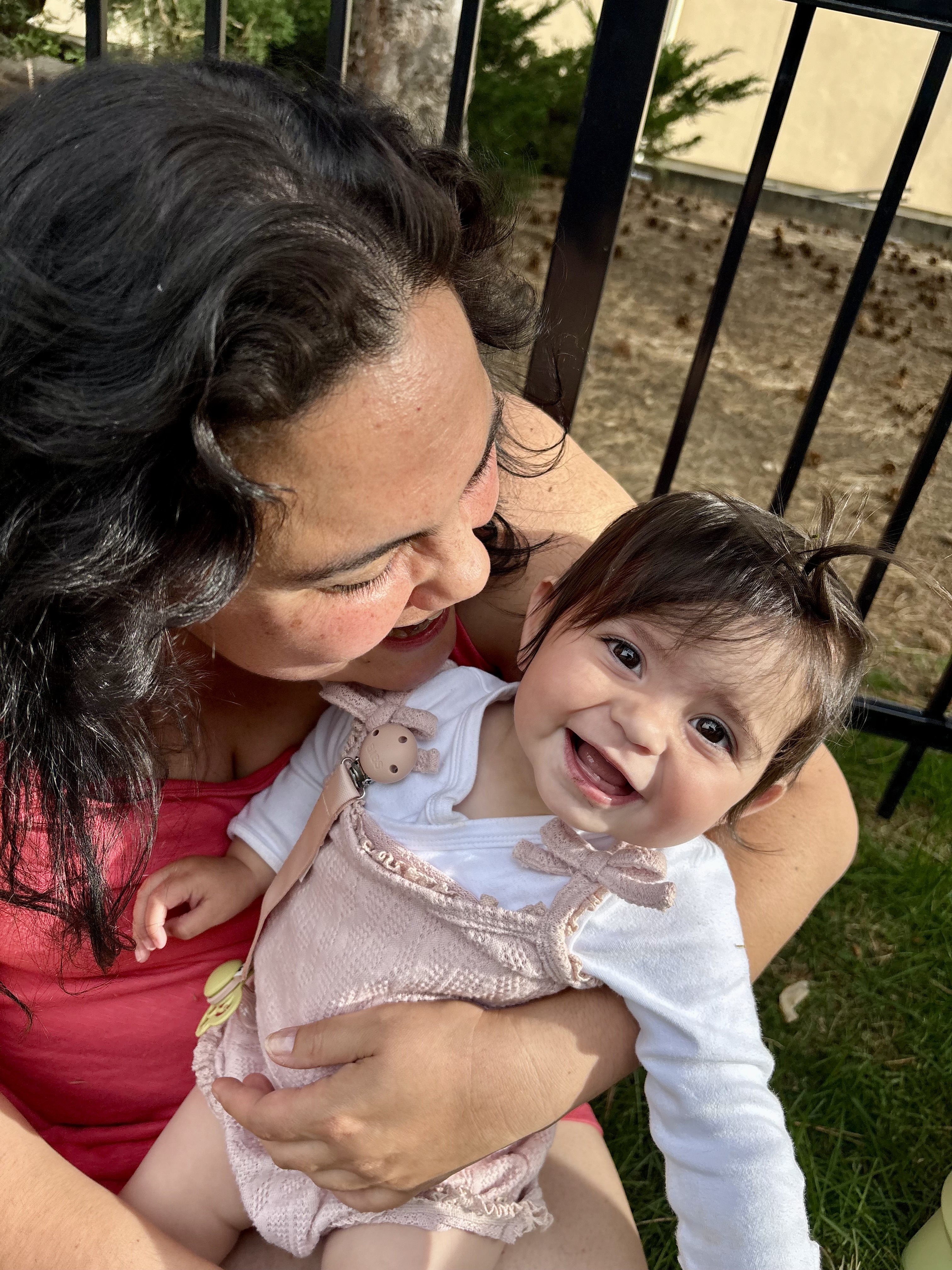
When Jen brought Callie to the emergency department, she did not want anything to be wrong. But Callie had been born weighing over eight pounds and was now barely six. Despite regular breastfeeding, where pre and post weights could confirm Callie was consuming two to three ounces each time, Callie’s weight had fallen by a stunning twenty-five percent. Even worse, by the cries her daughter made, Jen knew Callie was in pain. She just didn’t know why.
Today, Callie’s situation has shifted. She is 14 months old, weighs around 8.47 kgs (approx. 19 pounds), and is eating up to one cup of food and three snacks each day—which is fairly rare for individuals with her condition, known as Microvillus Inclusion Disease (MVID). Though some individuals may eat by mouth following an intestinal transplant—Callie has not had one, which is one reason why her story is so unique—most individuals with MVID rely on lifelong total parenteral nutrition (TPN). While Callie also depends on maintenance TPN, her feeding capabilities have changed since she began an investigative treatment at just three months old.

For Jen, Callie’s story is about more than her weight or her nutrition. It’s also about how and why we need to change the way we speak about rare diseases, or about health in general. Jen has been a huge advocate for language alterations in intestinal disease, specifically around the word “failure,” such as intestinal failure or failure to thrive. “It’s important to know that Callie isn’t failing. She didn’t fail,” Jen says. She expands on her beliefs in an Instagram post, writing:
Failure is too normative to refer to children whose development is not presently conventional! Diagnoses like failure to thrive or total intestinal failure hit families and caregivers where they already hurt. Flip the script with us and accuse the LANGUAGE of failing to do better.
Jen carries this fierce advocacy in every way she stands up for Callie. She knows she cannot fight every battle, but when it comes to her daughter, she’ll do everything in her power to make a difference. As Jen says, “I think it’s important to pick my battles, but once I pick it, I’m bringing it to the end.”
Callie’s Story
Jen feels lucky to have access to direct primary care, who sent the family home with a scale and checked in on them every day. Even as Callie’s weight kept falling, Jen was trying not to worry. Then one day, she could finally tell that Callie needed help. At the emergency department, doctors began running labs to see what might be happening. But it’s here that Jen received some conflicting information.
As Jen nursed Callie, the medical team originally told her that Callie’s vitals were fine. It didn’t seem like anything was wrong. Then, after a shift change, a second doctor ran into the room. In a panicked voice, he told Jen that Callie might be septic and that she needed a lumbar puncture.
The mixed communication, and the idea of her daughter undergoing such an invasive procedure, was frightening. Jen also didn’t understand why the physician who told her gave her such rushed information. It wasn’t until a nurse entered the room, and Jen expressed her displeasure—“I told her that whatever he just did, he cannot do again to another family,” she tells me—that she finally got some actual information.
“They said the first doctor said nothing was wrong, but when the labs came back, they were a mess,” Jen explains.
Callie was immediately transferred to the main campus because her situation was too dire for the satellite campus, but all the NICUs in the Denver Metro area were diverting at the time. Her family is grateful there was a bed for her in the PICU.

At first, doctors believe Callie might have a renal issue, then a metabolic one. However, after ruling out condition after condition, they determined that whatever she was dealing with was likely related to her gastrointestinal system. Though she was moved out of the PICU, she remained in the hospital to undergo more testing. Callie was started on TPN at three weeks old and not able to be discharged until she reached 4.5 kgs and passed a two-night glucose cycling test. They thought she would gain 50 grams per day, but it averaged less than half of that at first.
Establishing Boundaries
As doctors prepared Callie for an upper and lower endoscopy, as well as a small bowel biopsy with electron microscopy, Jen established a boundary with the hospital staff in order to protect herself from the temptation of looking up the disease or anything else that kept her from attending to the present moment.
She tells me, “I told them I didn’t want to hear the name of the disease until it is confirmed. I can sign with informed consent that you’re going to do the scopes, the surgery, and the biopsies. But I do not want any information until you know the exact name.”
Callie underwent her procedure on Thursday. The family was told not to expect results before the following Wednesday, but when the whole genetics team assembled first thing Monday morning, Jen knew they found what they hadn’t wanted to find.
The testing ultimately confirmed that Callie had microvillus inclusion disease. For the first time, Jen and her family had answers. Now they needed to figure out what to do next.
What is Microvillus Inclusion Disease (MVID)?
Also known as congenital microvillus atrophy, microvillus inclusion disease (MVID) is a rare inherited intestinal disorder caused by loss-of-function mutations in the myosin Vb (Myo5b) gene. STX3, UNC45A, and STXBP2 gene mutations have also been linked to MVID development. These mutations affect microvilli (structures on the cell surface) in the intestine. As a result, people with MVID cannot fully absorb nutrients, are expected to be TPN dependent for life, and are not ‘rehabilitation’ candidates.
“Because Callie had a normal NIPT and passed both Colorado Early Screens, the geneticist declared, ‘We won’t find anything here,’ but she wasn’t responding to anything and they had to look again. On the second pass, they found a pathogen in each of us, and on the third pass they were only looking at the one gene in each of us that could be the explanation. They then found a mutation in my husband’s MYO5B gene that had not yet been classified of significance. MVID is autosomal recessive, so after the electron microscopy and staining were also positive, his mutation was also linked to MVID,” Jen says. She hopes to be able to contribute to the medical literature by identifying the way in which Callie’s heterozygous presentation may yield functioning intestinal surfaces.
Symptoms and manifestations of MVID usually appear within hours to days after birth. These can include:
- Severe, watery diarrhea
- Vomiting
- Stunted growth
- Dehydration and malnutrition
- Significant weight loss (up to 30% of body weight)
The diarrhea is especially difficult to manage. According to the Cure MVID Association, “Stool production is 100 to 500 mL/kg/day when the infant is fed, a volume comparable to or greater than that observed in cholera. Diarrhea is of the secretory type and therefore persists even when fasting.”
Currently, no cures exist for MVID. Instead, MVID is typically managed with TPN, intravenous hydration as needed, and, in some cases, with intestinal or liver transplantation.
Overcoming Oral Aversion
Once Callie was diagnosed, the medical team was working to stabilize her. But Jen had another concern: she didn’t want her daughter to develop an oral aversion. Oral aversion happens when a child develops a strong objection or fear relating to anything being placed in or around their mouth. This aversion might develop in children who had certain medical procedures and now associate the mouth with pain, children who were intubated, children who have trouble swallowing, or for several other reasons.
Many children with MVID develop oral aversion, due to factors such as:
- Early use of TPN and a lack of oral feeding
- Nausea, vomiting, abdominal pain, and diarrhea when feeding orally
- Hospitalization and medical procedures requiring NG or endotracheal tubes
While Jen didn’t interact with the MVID community while Callie was in inpatient care—“When I searched the hashtag, only one of the saddest things I could imagine showed up,” she said—she had a close friend who insisted Jen needed to keep Callie’s oral skills up. Oral aversion can be challenging to come back from, which was reinforced with a conversation Jen had when she was later put into contact with another TPN mom from the hospital.
“Since Callie had been breastfed for the first two weeks of her life, she was already orally engaged,” says Jen. “It was important for us to keep that going.”
Although Callie spent 10 days on NPO (nothing by mouth), getting only flavored oral swabs and a few drops of Sweet-Ease in the morning, Jen began speaking to the doctors about feeding Callie orally. Jen believes Callie was indescribably fortunate to be treated by Lindsey Gumer, MD MSc, because she had treated another MVID patient who tolerated a small evening snack. Dr. Gumer was open to testing Callie’s limits and they have since learned that many families globally do not feel supported in this way.
Making Headway into Treatment Options
Shortly after Callie was discharged from her 70-day stay, Dr. Gumer emailed a small Listserv of intestinal failure specialists and one of them told her about a trial that was comprised of five children worldwide. Callie’s parents could not be more excited to give it a try, and they feel so grateful to the team who worked overtime to secure FDA approval and interstate logistics. Callie was also able to begin treatment with Crofelemer without an inpatient stay thanks to their diligent negotiations.
Crofelemer is a plant-based treatment derived from red bark sap from an Amazonian tree known as Croton lechleri. The bitter sap, known as “dragon’s blood,” has been used for decades in traditional South American medicine, treating conditions including diarrhea, bug bites, lung conditions, and other wounds. Research shows that Crofelemer works for diarrhea by targeting intestinal chloride channels to normalize intestinal fluid secretions.
“The coolest thing about this is that it’s literally purified tree sap,” Jen says. “We reconstitute it from powder and administer three small doses per day.”
Before reaching the targeted therapeutic dose, Callie started eating low-sugar purees, from root vegetables and green vegetables to fruits. But, after having been on Crofelemer for a year, Callie has made huge strides and is no longer limited to specific food items or restricted by quantity either. Her family draws labs every two weeks to monitor for any signs of electrolyte imbalance as they seek the upper limits of Callie’s capacity for intake and absorption. They know her team is as awestruck by her progress as her family is.

As you can see by the poster, Callie’s stool outputs sharply decline while taking Crofelemer while her weight inversely rises. Says Jen, “She stabilizes on a 25-percentile growth curve. From the time she was three months old and started the drug, doctors have not had to weight-adjust her TPN. We now have ten months of sustained growth without increased parenteral support. Twice this summer, we did add potassium acetate since it’s very hot outside and she’s so active. It’s incredible to think that we went from intense discussion about milliliters of breast milk to: ‘Have at it, Callie. Let’s see what satiety looks like for her.’”
While Crofelemer has been effective for Callie, Jen notes the need for increased research. She tells me that Crofelemer is the only investigative supplement for supportive care, and other families sometimes communicate skepticism. Despite these remaining challenges, this research represents the possibility that, someday, treatment could address the underlying disease rather than simply manage its consequences.
The Potential for mRNA
There’s another approach to care that Jen is also watching closely: mRNA therapy. This therapy uses messenger RNA (mRNA) to instruct cells on how to create certain proteins, replacing those that are missing or deficient. Unlike traditional gene therapy, mRNA therapy doesn’t permanently change a gene. The mRNA therapy is broken down by the body, eventually requiring re-dosing.
Ganesh Mamodaly, the founder and president of the Cure MVID Foundation in Paris, is working on an mRNA-based approach intended to target intestinal epithelial cells. The goal is to deliver the treatment that doesn’t dissolve until it reaches the duodenum and can provide instructions to replace affected cells. In mouse models, Jen says, researchers have been making progress.
Additional Management
Despite Callie’s ability to eat, she still also remains on TPN, though her TPN requirements have lessened. When she was first released from the hospital, she was infusing for 22 hours each day. Jen says, “Doctors were hoping we could knock off one hour a day each year. But after one year, we’re knocking off five hours, so she’s infusing for only 17 hours. That is life-changing for her and for us, both because it lowers hypervigilance and the risk of complications, and because it allows Callie to grow and explore enthusiastically, as she’d like to.”

Luckily, so far, Callie has dealt with few complications. She did develop a central line infection once, about ten months after it was placed. But Jen caught it quickly, and the line was cleaned and re-placed without any issues.
“A lot of things have worked out well for us,” she says. For instance, the French language piqued Jen’s interest before grade school through an advertisement for language learning video tapes. She went on to study and work in several Francophone countries, so it was encouraging when the recently established Cure MVID Foundation was in a neighborhood she knew well.
Therefore, when Jen learned Callie’s doctor was presenting at the European Society for Pediatric Gastroenterology, Hepatics and Nutrition (ESPGHAN), and it was in France, she knew she had to be there. After that she went to Germany to meet another MVID family. “The world becomes small when you’re talking about which country’s best practices really seem best for your child, such as taurolidine. This is currently only approved for adults in the U.S. but has been in pediatric trials. Anecdotes and European safety data make us eager to have access to it for Callie,” says Jen.
Jen often underscores the value of this outreach and cross-family communication. When your child has a rare disease, the ability to connect with even a handful of people who understand what your family is experiencing can make an enormous difference.
Why Language Matters
When families speak to physicians, or to each other, the language being used matters. It matters, on one level, for awareness. For expressing a shared experience. For getting across the complexities of day-to-day life.
On another level, language matters for the way we understand both a disease and those affected by it. As Jen recounts Callie’s story to me, she keeps coming back to the idea of language. She is eager to illustrate the point with something that happened at a vulnerable time in Callie’s admission and her own postpartum experience. She mentioned that “failure” was hurtful for her family, that her daughter was not failing. A physician attempted to rebut with the argument that more offensive language is still commonplace, to which she replied: “It shouldn’t be. You see how hard it is for me to have this conversation with you and that should indicate how many families don’t even bother.”
The specifics are disheartening. But the opportunity for the intern who spoke up in support and everyone else learning in the room that day was worth it. Jen has also taught undergraduates, and she is sure that conversation will have ripple effects. “Words matter,” she says.
That is why Jen continues to share Callie’s story whenever she’s able to. Why she questions “intestinal failure.” And why she wants people to understand the distinction between a body that isn’t functioning properly and someone’s actual capabilities.

Jen knows Callie will grow up in a world where people may not understand her disease. They may not understand why she has a central line or why she needs TPN. They may see her at one point in the day and gawk and shudder at what they don’t understand, then see her later that day and have no idea she’s the one they reacted to earlier. MVID is both visible and invisible in that way.
But Jen has already seen what can happen when a family keeps asking questions, keeps advocating, and encounters extraordinary clinicians who feel like championship teammates. And she wants other parents to know that they don’t have to accept every word that is handed to them along the way. Especially not the word “failure.”


Leave a Reply