
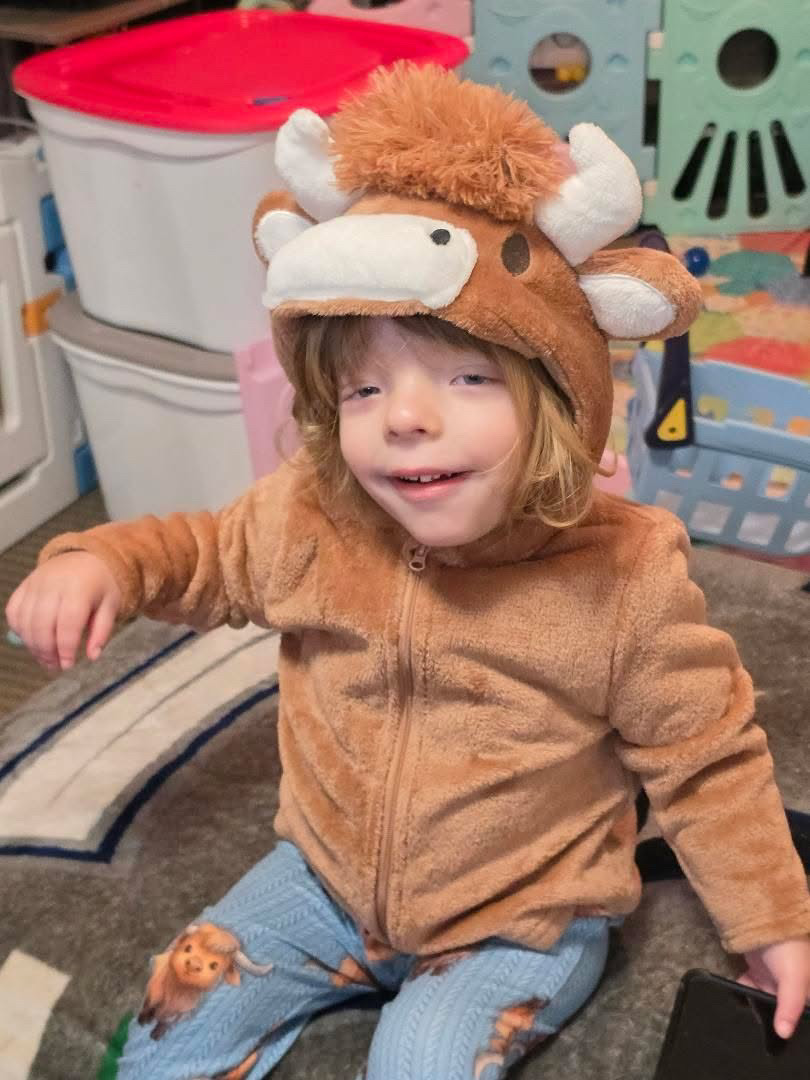
Ask Brighton’s mom Tanya which milestones she celebrates, and she doesn’t hesitate: every single one. Gaining strength. Finding a new method to communicate. Cruising around furniture with his walker—his blonde curls bouncing, blue eyes twinkling, and his characteristic smile stretched across his face.
“Nothing is ‘just’ a milestone in our house,” she says. “Every new skill represents hours of therapy, repetition, determination, and him refusing to give up. Some milestones take him longer to reach. But when he gets there, they mean that much more because we know how hard he worked to earn them.”

At three years old, Brighton has already taught his family that progress may not follow an expected timeline, but that doesn’t make progress any less meaningful. That just because something looks different than what was imagined, that doesn’t make it lesser.
When he was initially diagnosed with Coffin-Lowry syndrome, his parents didn’t know what the future might hold. But now they look at their son and they couldn’t be prouder of the person he is today.
“There are absolutely hard days. There are terrifying days. There are exhausting days. But there is also so much joy,” Tanya explains.
In her interview with Rareatives, Tanya shares more about Brighton’s journey to diagnosis, how it gave more insight into her own health, her advice for other families, and why it’s important to see the child behind the diagnosis.
After all, she asserts with a smile, “Brighton is Brighton first and a child with Coffin-Lowry syndrome second.”
Brighton’s Story
Tanya’s pregnancy was marked by various complications. At the time, it wasn’t clear exactly what was causing these complications, though Brighton’s eventual diagnosis brought answers to her own life-long health complexities.
Because of these complications, doctors were frequently monitoring Tanya and Brighton’s health. When Brighton was 30 weeks and six days old, doctors noted that he had significant growth restrictions in the womb, known as intrauterine growth restriction (IUGR). Prior to this moment, Tanya had believed she would be having a large baby.
Concerns about Brighton’s growth, and that he was not growing as intended, led to his early entrance into the world at 36 weeks and three days old. At 17.3 inches long, weighing just 4 lbs. 1.7 oz., Brighton was “below the 1st percentile in weight and at the 0% in height,” says Tanya. But doctors weren’t yet thinking that his small stature, could be related to any underlying genetic condition. Instead, they believed the growth restrictions were likely associated with potential placental issues. Brighton spent several weeks in the NICU building up his strength before he was released home to his parents.

On Tanya’s Instagram page, where she shares Brighton’s journey, she wrote for NICU Awareness Month in September: “I’ll never forget leaving the hospital without him. I’ll never forget the monitors, the wires, the beeping, the tiny diapers, and learning a whole new language I never wanted to know. I’ll never forget celebrating things most parents never have to think twice about — gaining a few grams, finishing a feed, maintaining his temperature, and getting one step closer to coming home.”

Having a child within the NICU can be frightening. If you need additional support, consider checking out these resources from the Maternal Mental Health Leadership Alliance.
The Search for Answers
For the next few months, Tanya and her husband relished in the joy of having their son with them. Yet, despite following his own growth curve, Brighton still wasn’t growing as much as doctors would have liked to see. He was diagnosed with failure to thrive, which essentially means that the growth of height and weight falls below growth chart norms. By the time he was seven months old, he was still only around the 1st percentile for both height and weight.

At this point, Brighton’s pediatrician had grown suspicious that there was a deeper cause to Brighton’s size, as well as his hypotonia (low muscle tone). Tanya vividly remembers the moment after Brighton’s chromosomal microarray came back negative. “His pediatrician looked me directly in the eye and said, ‘I do not like that answer,’” Tanya explains. “She wasn’t willing to stop looking simply because one test came back normal.”
The pediatrician then referred the family to genetics. But the challenge is that pediatric genetic wait times can be significant, often upwards of several months depending on the area where someone lives. So they were placed on the waitlist. And for a while, they were willing to wait—although, admittedly, the waiting can be tough.
Then Brighton began having seizures.
At fourteen months old, their bright, bubbly son was hospitalized. He experienced thirteen seizures throughout his stay, including ten in a 48-hour period alone. “It was terrifying,” Tanya says about the five-day hospitalization, which ultimately led to a diagnosis of focal epilepsy with right temporal onset. “Some of his seizures included stiffening, turning blue, not breathing, and vomiting afterward.”
But, during the hospital stay, the family was finally taken off the genetics waiting list. “We actually had a nurse and paramedic ambulance escort us to our children’s hospital so we could attend the appointment,” says Tanya.
The geneticist they met shared that Brighton’s developmental delays, seizures, and slowed growth all suggested a potential genetic disorder. Brighton underwent genetic testing, “but none of us could have guessed where that testing would eventually lead,” says Tanya.
In September 2024, there was finally an answer: Coffin-Lowry syndrome.
What is Coffin-Lowry Syndrome?
Coffin-Lowry syndrome is a rare genetic disorder caused by changes in the RPS6KA3 gene, which plays a role in cellular signaling and brain development. Because Coffin-Lowry syndrome is inherited in an X-linked dominant pattern, the condition tends to affect males more significantly than females, as males only have one X chromosome.
A few months after Brighton’s diagnosis, testing showed that he had inherited the affected RPS6KA3 gene from Tanya. “We went looking for answers for our son and unexpectedly found answers about me, too,” she tells me. “I had gone my entire life not knowing that I was affected by Coffin-Lowry syndrome. I’m considered an affected, or manifesting, carrier. Suddenly, pieces of my own life and medical history—the symptoms I’ve struggled with throughout my life—began making more sense. Doctors even believe my heart issues may be related to CLS and have existed before pregnancy, with pregnancy exacerbating them.”
It’s important to note that CLS is incredibly variable. The signs and severity may vary from person to person, and do vary significantly between males and females. Characteristics and manifestations of Coffin-Lowry syndrome can include:
- Distinctive facial features, including a prominent forehead, widely-spaced eyes, and a wide mouth with full lips
- Microcephaly (small head size)
- Short stature
- Kyphoscoliosis (progressive abnormal spinal curvature)
- Hypotonia
- Problems with muscle coordination
- Stimulus-induced drop episodes (SIDEs), in which a sudden touch, sound, or unexpected stimulus causes the sudden loss of muscle tone—“Brighton has not experienced these classic episodes,” Tanya says.
- Intellectual or cognitive impairments
- Developmental delays
Seizures, like Brighton has, have been related to CLS—and, in his case, doctors have stated that they do believe his CLS is the cause. However, seizures are rarer for individuals with Coffin-Lowry syndrome.
“Thankfully,” Tanya shares, “Brighton has responded incredibly well to medication and has been seizure-free for about two years, although his MRI in June suggests there might be some seizure activity.”
Overcoming Obstacles
Brighton was also diagnosed with scoliosis at 19 months old. He began Mehta casting at two years old after his curve progressed from 29° to 35°. Over the years, Brighton has gone through five casts, though his final cast was removed in June 2026. While he still wears both day and night braces, he has never let his situation be a limitation.
“His body has asked a lot for him in his first three years. He has had to work incredibly hard,” Tanya says. “But one of the biggest things I wish people understood is that a diagnosis can tell you things about your child, but it cannot tell you who your child will become. When you first receive a rare diagnosis, you’re handed an overwhelming amount of information about everything your child might struggle with. It’s very easy to look at that list and accidentally start seeing limitations before your child has even had the opportunity to show you what they’re capable of.”
Today, “Brighton runs on Brighton time,” as Tanya puts it. At three years old, Brighton is non-verbal, still small in stature, and not yet independently walking.
“But none of those tell you how funny, stubborn, loving, determined, and full of personality he is,” Tanya shares. “People sometimes think that milestones have an expiration date. They don’t. Just because a child doesn’t accomplish something according to the timeline printed on a developmental chart doesn’t mean they won’t accomplish it.”

When Tanya thinks back to when she was first diagnosed, she remembers the overwhelm of feelings that so many parents within the rare disease space face. But, looking at everything now, she wishes she could tell herself that it would be okay. That she’d have a son who loves Bluey, Toy Story, and anything that lights up. That he’s strong, determined, and won’t let anything stop him.
“I would tell myself that things might seem hard now, but that little boy is going to do things every day that shock you. There will be long days and even longer nights. Appointments, therapies, worries, and moments when you’re completely exhausted. But you’re also going to fall in love with him and his little personality more every single day. Don’t spend so much time being afraid of everything he might not do that you miss everything he’s showing you he can do. He’s going to surprise you,” Tanya muses. “Again and again and again.”

One of the reasons why she feels so strongly about sharing Brighton’s story and raising awareness around Coffin-Lowry syndrome is so that other parents can take advantage of this advice, and so that other parents know that they’re not alone. Tanya says that sometimes people look at rare disease families and see the appointments, hospital stays, medications and therapies, diagnoses, specialists, equipment, and more, and assume that their lives must be sad.
She wants other CLS families to know: it doesn’t have to be sad. Whether she’s speaking with the Coffin-Lowry community on Facebook, meeting families in person, or simply sharing their experience on Instagram, her goal is that one day, “when another family types ‘Coffin-Lowry syndrome into a search bar, scared and searching for someone who understands, they can find stories like Brighton’s. We hope they see there can be joy alongside the unknown.”
For parents who are at the start of their diagnostic journey, or who have just received their child’s diagnosis, Tanya has some advice for you. First, be an advocate for your child. You know your child, and you know when something isn’t right. Ask questions and keep asking them. If your doctor isn’t listening to you, find someone who will, someone who is willing to say “I don’t know, but let’s figure it out together.”
But most of all, she says, “Try not to let everything you read about what could happen steal the child who is standing right in front of you.”



Leave a Reply